
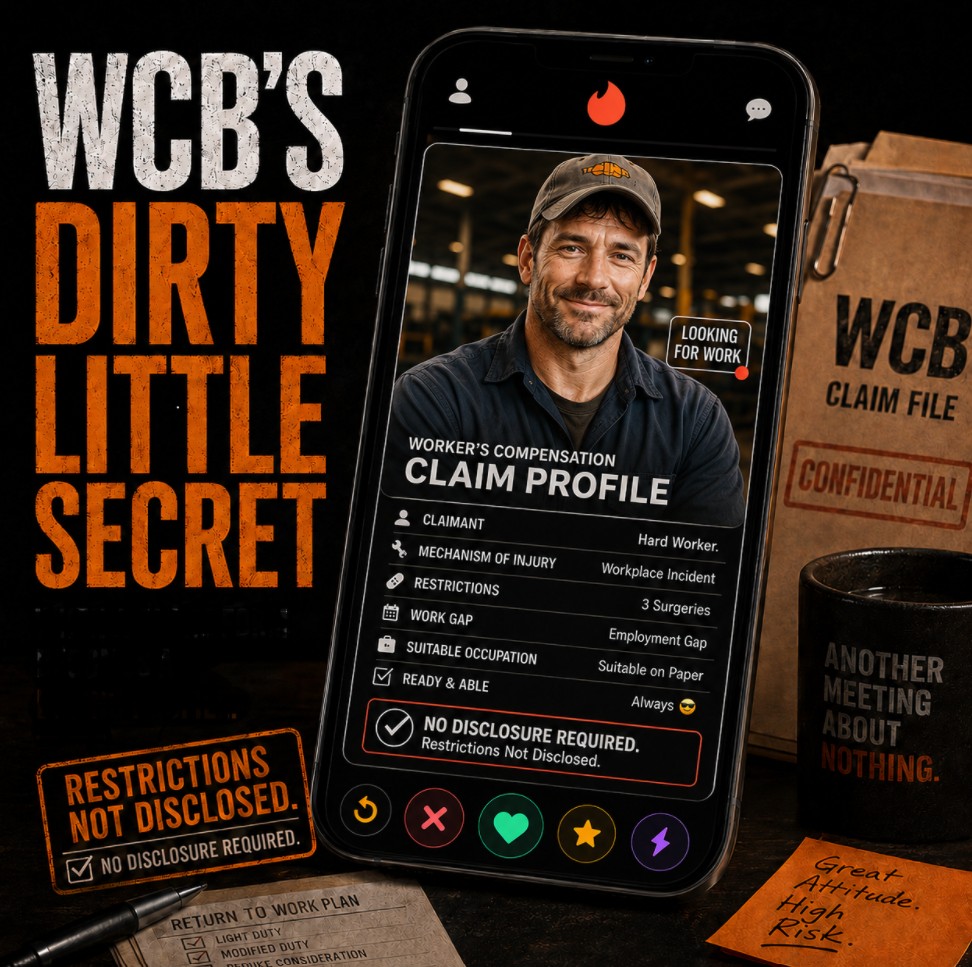
WCB’s Dirty Little Secret: A Tinder Strategy for Injured Workers
You’ve seen the dating profiles. Six-foot-two, chiselled jawline, adventurous but sensitive, loves hiking and fine dining. Then you show up at the restaurant and spend the evening reconsidering every life choice that led you to this table. It’s called catfishing. WCB calls it vocational rehabilitation.
Now imagine the catfish is an injured worker, the prospective employer is the unsuspecting date, and the matchmaker urging the whole deception along is the Workers’ Compensation Board. This is what injured workers across Canada are quietly being told to do.
First, some context, because this only makes sense if you understand how the re-employment machine works.
When a worker is seriously hurt on the job and can’t return to their previous role, WCB’s vocational rehabilitation program kicks in. In principle, the process is straightforward: assess the worker, understand what they’re capable of, identify suitable employment, and support them in getting there. Done right, it’s a reasonable program.
The key word is suitable. Under WCB policy and applicable case law, a genuine suitability assessment is supposed to consider the whole person. That means physical capacity, yes, but also psychological capacity, cognitive capacity, vocational background, education, age, pre-existing conditions both compensable and non-compensable, and whether any of it actually fits together in a job a real employer would hire someone to do. It’s supposed to be a serious, individualized exercise, not a name pulled from a job board.
In practice, it often isn’t.
The board has a financial interest in closing files. Every worker identified as having a “suitable occupational direction” is a worker whose ongoing wage loss benefits can be reduced or ended. So the pressure, conscious or not, runs toward finding something on paper rather than something that actually works. A former forklift operator with destroyed hands gets pointed toward appointment coordinator. A millworker with a wrecked back gets aimed at data entry. The logic, from a cost-containment perspective, is tidy. From a human perspective, it can be absurd.
Blue Collar Consulting just won a landmark appeal at the Appeals Commission for Alberta Workers’ Compensation that speaks directly to this. Decision 2026-0244, issued May 25, 2026, concerned a worker who had been employed as a forklift operator before developing bilateral carpal tunnel syndrome requiring multiple surgeries. WCB identified appointment coordinator as a suitable occupation and cut off his supported job search on that basis. The Commission reversed that decision completely, finding the position was inconsistent with the worker’s permanent physical restrictions, particularly his limitations around bilateral hand use, keyboarding, speed, and accuracy. The Commission also addressed WCB’s suggestion that voice recognition technology would bridge the gap, finding it would not realistically work for this worker in this role. Both issues were decided in the worker’s favour. WCB’s suitability determination was thrown out, and the worker was entitled to continued re-employment support to find an occupation that actually fits.
What makes this significant beyond the individual case is that the Commission reaffirmed that the whole person standard applies. Suitability assessment must account for compensable and non-compensable conditions together, must weigh physical, vocational, social, and psychological circumstances, and cannot be satisfied by identifying a position that works on paper but fails in reality.
Which brings us to the catfishing.
Even when WCB’s job matching is done in good faith, even when a suitable occupation is genuinely identified, the board’s guidance to workers about how to pursue that work creates a serious problem. The injured worker sits down to write a résumé with an unavoidable gap in it. A big one. When they ask WCB how to explain the time away, the restrictions, the body that no longer works the way an employer expects, the answer is some version of: you don’t have to say anything.
WCB’s cover for this advice is human rights legislation. Employers are prohibited from asking about disabilities during hiring, and workers have no legal obligation to volunteer that information. This is true, and it matters as a principle. But WCB uses it as a full stop when it should only be a comma.
The reality of hiring doesn’t work the way the legal framework pretends it does. An employer interviewing someone with a two-year gap in their résumé, limited range of motion, and a history of multiple surgeries is not going to shrug and say nothing to see here. They’re not going to ask directly, because they know they can’t. But they are going to notice. They are going to factor it in. They are going to make a decision, and the worker is going to be on the wrong end of it, and neither of them will ever say why out loud because the law has made that conversation officially off-limits while doing nothing to make it actually disappear.
WCB knows this. Every reemployment specialist who has ever worked a real file knows this. Hiding behind the fact that employers can’t legally ask doesn’t change what employers actually do. It just gives WCB plausible deniability while leaving the worker to navigate the gap between the legal fiction and the lived reality entirely on their own.
It puts the injured worker in an impossible spot. They’re being coached to begin a new employment relationship built on omission, which is still deception, however technically legal. They are the polished profile picture standing in for the actual person. When the employer eventually finds out, and they will, the worker is the one holding the bag. The employer feels misled, the relationship is poisoned, and the worker who was already on shaky ground is now worse off than before. WCB, having already cut benefits on the theory that suitable work was available, has moved on.
The worker didn’t want any of this. They were hurt on the job, then ground through a system that spent years disputing their restrictions and questioning their credibility, and the system’s parting advice is to go deceive a prospective employer and hope for the best. The right to privacy around a disability is worth protecting, but there’s a difference between privacy and being coached into a fiction you can’t sustain. Honest disclosure is frightening when you know it’ll probably cost you the job, and workers aren’t wrong about that. Discrimination in hiring is nearly impossible to prove. So the math is brutal: be straight with the employer and lose the opportunity, or stay quiet and maybe survive three weeks before it unravels anyway.
WCB’s answer to that dilemma isn’t better job matching, stronger anti-discrimination enforcement, or more realistic assessments of what injured workers can actually do. It’s a filter and a nudge toward the submit button.
This is exactly where I push back on the board. Catfishing your way into a job isn’t a re-employment strategy. It serves one party: WCB, which gets to close the file and record a successful outcome. For the worker it’s a clock running down. Durable employment, the kind that actually changes someone’s situation, has to be built on something real. That means rigorous suitability assessments that account for the whole person, not just the compensable injury on file. It means honest conversations about what a worker can and cannot reliably do. It means employers who know what they’re taking on. And it means being willing to keep a file open until the right fit is found, rather than forcing a square peg into a round hole and calling it rehabilitation.
WCB measures success by file closure. Injured workers measure it by whether they still have a job six months later. Those are not the same number, and the gap between them is where injured workers get left behind.
Blue Collar Consulting represents injured workers navigating the WCB system in Alberta. If you’ve been through the re-employment process and have a story to tell, we want to hear it.