
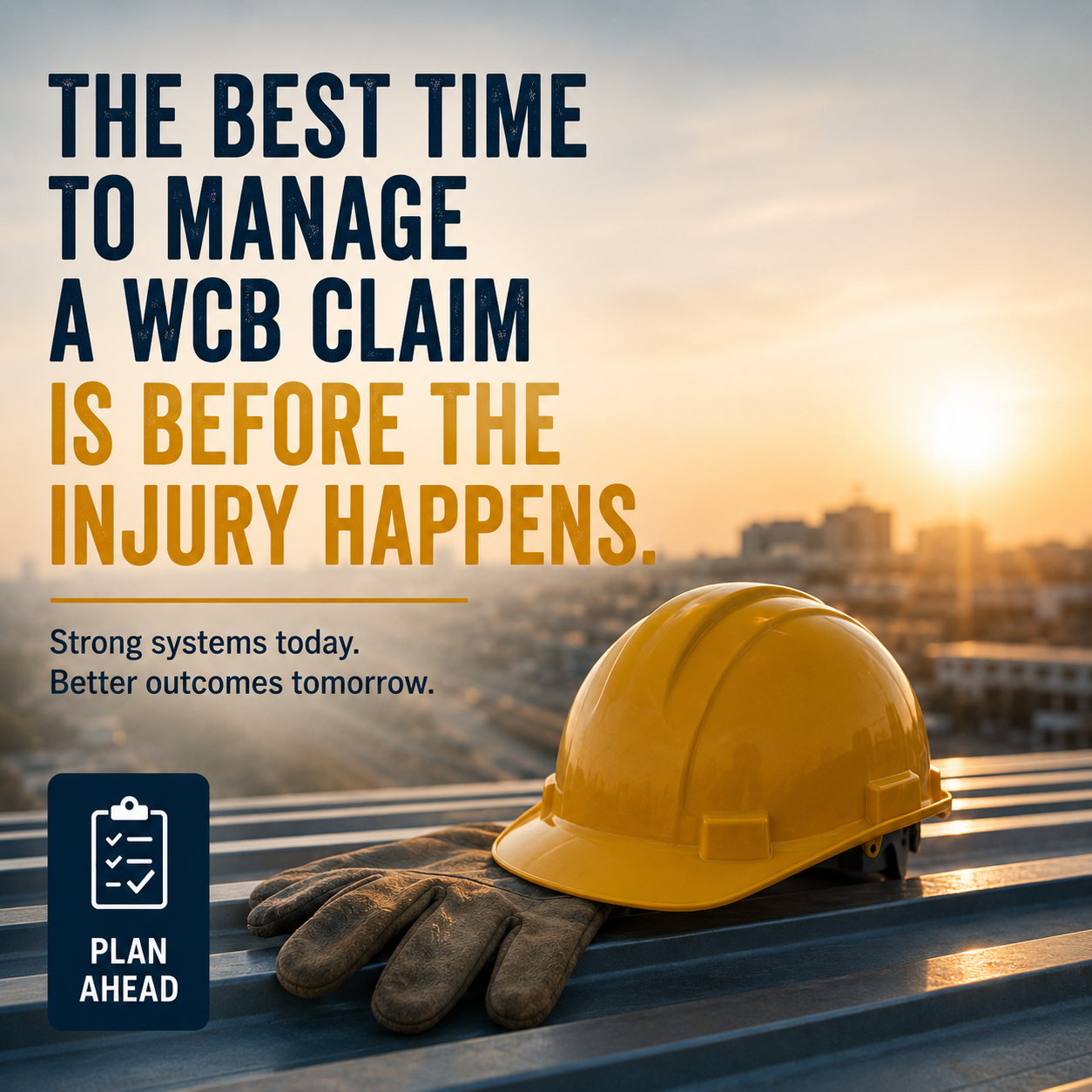
It’s common for employers to think a WCB claim begins the day someone gets hurt. In reality, many of the factors that determine how that claim unfolds were established weeks, months, or even years earlier through the systems, expectations, and workplace culture built long before the injury happened.
One of the biggest misconceptions I see among employers is the belief that disability management begins when an injury is reported.
It doesn’t.
By the time your supervisor receives that phone call, your claim management system has already been put to the test. The quality of your documentation, the strength of your modified work program, the confidence of your supervisors, and the expectations you have established with your workforce will shape everything that happens next.
You’re either working from a proactive plan, or you’re scrambling and improvising under pressure.
I’ve watched both scenarios play out hundreds of times. The difference between them is rarely luck.
Most Claims Don’t Become Costly Overnight
Business owners rarely forget the claims that drag on for a year. They remember the worker who never came back, the premium increase that seemed to come out of nowhere, and the chaotic scramble to replace an experienced employee.
What often gets forgotten are the dozens of small decisions that quietly pushed the claim in that direction.
Nobody knew who was responsible for contacting the worker. The supervisor had never offered modified work before. Medical information sat on someone’s desk for several days before anyone reviewed it. The employer wanted to help, but there wasn’t a process for doing it.
On their own, none of those missteps seem particularly serious. Together, they create a claim that begins to drift. And drifting claims almost always cost more than they should.
That’s where many employers get caught off guard. They focus on the injury because it’s the most visible part of the claim. In reality, it’s often the small operational decisions that quietly determine whether a claim stays on track or slowly begins to unravel.
Claim costs aren’t driven only by the injury itself. They’re driven by how consistently the claim is managed from day one.
Effective Disability Management Is Really About Reducing Complications
The first few days following a workplace injury often determine how the rest of the claim unfolds.
The worker is trying to understand what’s happened. Supervisors are balancing production demands while figuring out what comes next. Documentation needs to be completed. Medical appointments need to happen. Questions start coming from the WCB. Everyone is looking for direction.
Without a plan, those first few days quickly become reactive. With a plan, they’re remarkably calm.
Most employers genuinely want to do the right thing. That’s rarely the problem. The challenge is that good intentions alone don’t create an effective disability management system.
From the outside, a disability management system can look like documentation, forms, and procedures. It’s easy to dismiss those things as bureaucracy. In reality, they’re what allow everyone to respond with confidence when an injury happens.
Instead of trying to figure things out under pressure, people already know what to do, who’s responsible, and what comes next.
Good systems don’t create more work. They eliminate the rework caused by missed communication, inconsistent expectations, delayed decisions, and preventable misunderstandings.
When those systems are already in place, supervisors aren’t trying to figure things out after an injury happens. They already know:
- Who contacts the worker
- What documentation needs to be completed
- What modified work is available
- How the claim should be moved forward
Recovery becomes the priority instead of paperwork.
Workers Notice How the Employer Responds
Workers notice far more than employers sometimes realize.
They notice whether someone genuinely checks in, whether modified work has already been planned, and whether recovery feels like a shared objective or someone else’s problem to solve.
Those moments build trust. Trust encourages cooperation. Cooperation keeps claims moving forward. I’ve seen employers spend thousands of dollars trying to resolve claims that began with something as simple as poor communication. I’ve also seen complex claims remain remarkably positive because the employer established trust from day one.
The difference usually isn’t the severity of the injury. It’s how the worker experienced the employer throughout their recovery.
Strong Systems Don’t Depend on One Person
A good supervisor can retire. An experienced HR manager can move on. A business can double in size over just a few years.
Without documented processes, consistent training, and clearly defined responsibilities, every new injury depends on who happens to answer the phone that day.
That’s an expensive way to manage risk.
The organizations that consistently control claim costs don’t rely on individual experience. They build repeatable systems that produce consistent outcomes regardless of who’s managing the file.
That’s organizational resilience.
It isn’t about avoiding disruption. It’s about responding to disruption consistently, with processes that keep people supported, claims moving, and the business operating.
Planning ahead doesn’t eliminate injuries. It eliminates uncertainty.
Modified Work Should Never Be an Afterthought
One of the first questions employers often ask after an injury is:
“What can this person do?”
It’s a natural question. It’s also one that should have been answered months earlier.
Employers who consistently achieve better claim outcomes usually have one thing in common: they’ve already identified productive work that can accommodate temporary restrictions before it’s ever needed.
They know where meaningful work exists inside their operation, even when it doesn’t fit neatly into someone’s regular job description.
When that preparation has already happened, returning someone to work becomes a practical discussion instead of a last-minute brainstorming session.
Just as importantly, the worker sees something else. They see an employer that planned for their recovery before they ever needed it.
That sends a clear message about the workplace culture. Their employer wasn’t simply prepared for an injury. They were prepared for the person behind it.
This Isn’t Just About WCB Premiums
Reducing premiums is important, but focusing only on premiums misses the much bigger business reality.
An extended claim rarely affects just one department. It quietly spreads through the entire business.
Supervisors spend more time reshuffling schedules. Experienced staff burn out while covering extra work. New hires require expensive training. Projects slow down. Customer commitments become harder to meet. Valuable institutional knowledge walks out the door when experienced employees decide not to return.
These costs rarely appear together on a financial statement. They quietly spread across departments, making them easy to overlook and surprisingly difficult to measure.
A functioning disability management system isn’t a decorative HR program.
It’s an operating system for controlling:
- Claim duration
- Lost-time exposure
- WCB premiums
- Replacement labour
- Retraining costs
- Supervisor time
- Group benefit pressure
- Productivity loss
- Operational disruption
It can also help protect bidding power in industries where WCB metrics, total recordable injury frequency, safety performance, and contractor prequalification matter. Done properly, disability management protects workers, protects margins, and prevents injury and illness management from becoming an insidious drag on the business. That’s a much bigger conversation than premium reduction.
How Blue Collar Consulting Partners With Employers
Most employers understand that workplace injuries should be reported promptly and that modified work supports recovery.
The challenge many organizations face is not recognizing these principles. It’s transforming them into a consistent, repeatable system that works just as well on a busy Tuesday morning as it does during a training session.
That’s where Blue Collar Consulting partners with employers.
We help organizations build practical claim management systems before they’re ever needed. From supervisor training and documentation processes to modified work planning and ongoing claim management support, we help employers replace uncertainty with consistency.
Our role isn’t simply to help manage one difficult claim. It’s to help build the systems, confidence, and processes that keep future claims from becoming difficult in the first place.
Because the goal isn’t simply to manage the next WCB claim more effectively.
It’s to build a workplace where injuries are managed so consistently that they stop becoming one of the hidden forces quietly holding the business back.