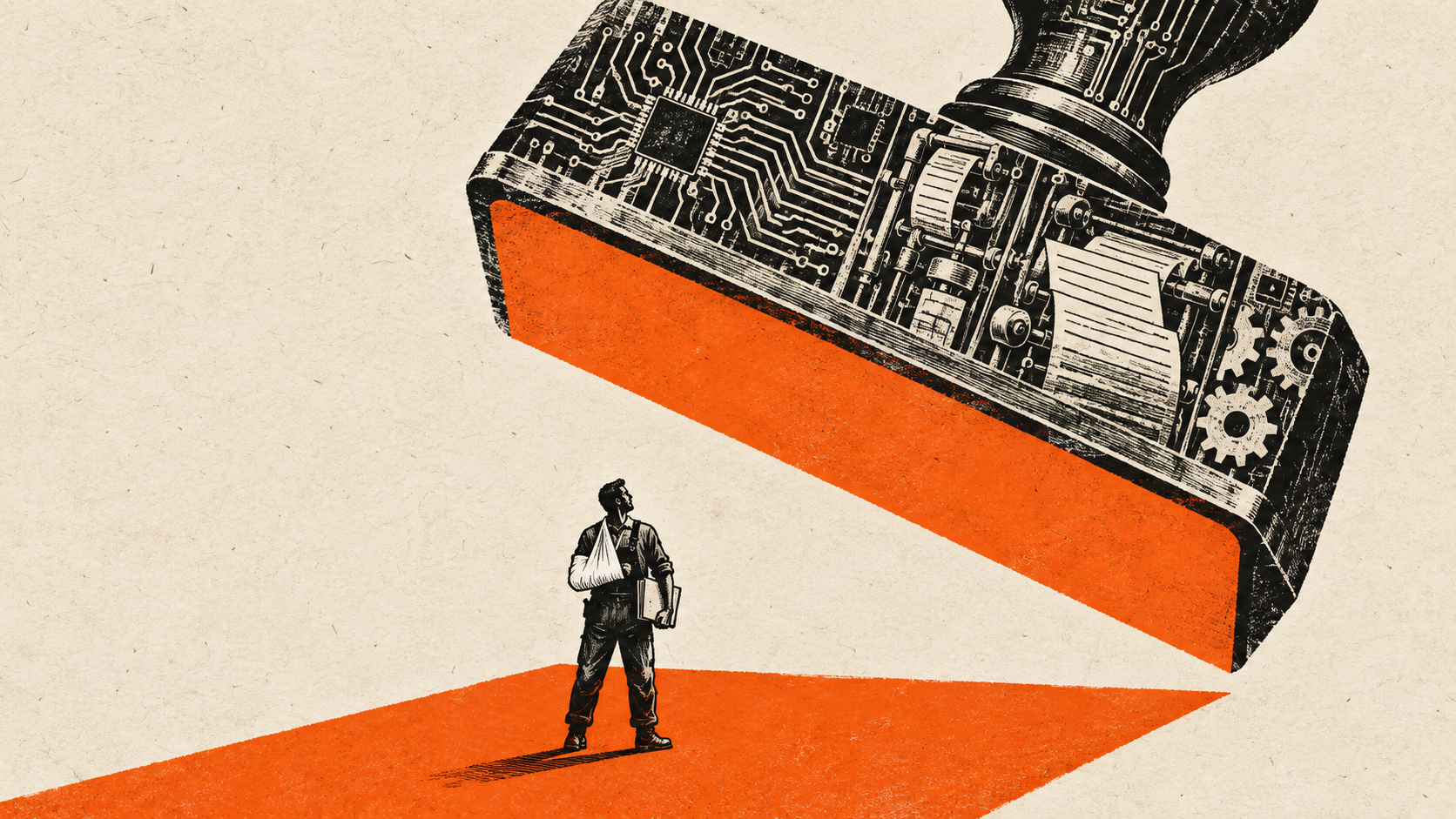
What artificial intelligence could mean for Alberta WCB and the workers waiting for answers.
The arithmetic
Start with the timelines, because they explain much of what follows. In the contested WCB files I handle in Alberta, a worker can wait four to six months just to have a review assigned to a resolution specialist. Getting to a hearing can take another four to six months. Then comes the wait for a decision, which can run another four to six months, sometimes longer. That’s twelve to eighteen months for the internal review alone, with some files stretching closer to two years. Proceed to the Appeals Commission and another year can pass before the worker has a final answer. These are the waits I encounter in my practice, rather than a published average for every review, but that distinction offers little comfort to a framer with a wrecked back who still has to pay the mortgage.
I’ve been doing this work for eight years, and the delays have become a larger part of the job. So has explaining them to people who cannot afford to wait. I don’t attribute that to everyone at WCB being idle or incompetent. I’ve dealt with enough overloaded case managers to know better. But whatever the explanation, the worker is left carrying the consequences, often while trying to recover from an injury, keep a household together, and make sense of decisions that will determine how the next several years of life unfold.
What’s pressing on the system
The backlog isn’t a bad year. Several things are converging, and they compound one another.
The workforce is aging. Older workers get hurt worse and recover more slowly, which means longer claims, more permanent impairment, and far more argument about what a person can still reasonably be expected to do for a living. That last category is the most expensive and most bitterly contested territory in the system. A worker in his late fifties has spent thirty years doing heavy work, gets hurt, and is left with permanent limitations. Treatment may be finished, but the question of what he can do for a living remains wide open. His work history, education, medical limitations, and the jobs actually available to him all become part of the dispute.
Psychological injuries are now accepted in genuine volume, which is a welcome development and a long overdue one. But they are markedly harder to adjudicate than a fractured wrist. They bring competing diagnoses, disputed causation, and questions about whether a return to work is realistic or premature. These files can require extensive medical clarification and generate difficult disputes.
And claims generally have grown more complex. Chronic pain presentations, several injury sites at once, or a preexisting condition that had never stopped someone from working until the workplace injury came along.
Difficult files take time, and the backlog adds to the work. I see a particular slice of this, of course. People generally come to me because something has gone wrong. Even allowing for that, the amount of evidence and judgment these files require is considerable. And the work doesn’t stand still while a review sits in a queue. More medical reports arrive, another assessment takes place, and another decision may have to be challenged before the first dispute is resolved. By the time someone picks up the file, there is often considerably more to sort through than there was when the review was requested.
Where judgment gets squeezed
The disputes I keep encountering have a familiar quality. A request for help with personal care or home maintenance turns into an argument about what a spouse should be expected to do. A return to modified work moves ahead despite medical evidence that raises questions about the timing or duties. A retroactive job search produces an earnings estimate for work the person never actually performed, reducing the wage loss benefits otherwise payable. Each decision has to be examined on its own facts, but the pattern I see is that the difficult question too often goes unasked. Could the worker actually sustain those duties? Was that job realistically accessible? What assistance does the worker need, and what is being assumed about the family?
Answering those questions properly usually requires another call, a better job description, or clarification from a physician. Sometimes it means revisiting a conclusion that has already been put in a letter. Under that kind of workload, it is simply easier to move a file along using the information already at hand than to stop and ask what might be missing. The case manager may sincerely believe the question has been answered. From my side of the desk, I’m often looking at the very piece of evidence that should have prompted another question. Resolving that difference takes time neither side has much of, while the worker waits for an answer that actually deals with the problem.
That’s the environment in which I expect artificial intelligence to become increasingly attractive. Over the next one to three years, I expect it to play a growing role in how workers’ compensation claims are handled in Alberta, with the pressure to shorten delays providing a strong reason to adopt it. That is my prediction, not a claim that WCB is currently using AI to decide the files I handle. The likely uses are fairly ordinary: summarizing a four hundred page claim file, sorting incoming information, flagging a report for review, or preparing a first draft of a decision letter for a case manager to check and sign.
I use these tools daily in my own practice, and they help me do my job. If software helps a case manager find the relevant specialist report buried on page 212, the worker stands to benefit. If it cuts months from a wait without sacrificing the quality of the decision, better still. I’d welcome that. But checking the work is part of using these tools properly. A summary can sound entirely reasonable while leaving out the fact that changes the case, and a draft can give a weak conclusion a very convincing explanation. My concern is whether the person reviewing it will have enough time to go back to the source, and whether, once the summary is on file, everyone who comes afterward will simply rely on it.
The spaces between the rules
Policy cannot anticipate every situation. Every worker brings a different medical history, workplace, injury, and set of circumstances, and sooner or later a file arrives that doesn’t look much like the example in the manual. Decision-makers have to work within legislation and policy, but they still have to decide what the evidence establishes and how the applicable provisions fit the case. WCB’s own initial entitlement procedure calls for discretion and reasonable judgment in making fair decisions. The existence of a rule does not relieve anyone of the responsibility to understand the facts they are applying it to.
Much of my work involves arguing about that application. A job may fall within a worker’s lifting restriction but require repetitive hand use the worker cannot tolerate. A medical report may describe improvement without saying the person can sustain a working day. A family member may be physically capable of helping without being available to provide all the assistance required. These are practical distinctions with serious consequences. They can determine whether someone receives benefits or is expected to live on wages they have no realistic way of earning. A decision may appear perfectly consistent with the policy until you look closely at the assumption holding it together.
AI may help identify those problems, and I wouldn’t dismiss its ability to do so. What worries me is that a polished answer will be accepted before anyone asks the follow-up question. Once the proposed conclusion is sitting there, complete with a plausible explanation and the appropriate policy references, the reviewer has to be willing to pull it apart. That is a different task from checking whether the letter reads well. If the expectation is that software should allow everyone to handle more files, there may be less room for that kind of scrutiny, particularly on the files that need it most.
The map and the road
Most of us have had a GPS direct us somewhere that made no sense once we got there. The turn existed on the screen, but on the road there was a locked gate or a sign saying the route was closed. A claim file can create a similar problem. On paper, there is a job description, a set of restrictions, and a medical opinion. Put them together and the return to work looks straightforward. Then you speak to the worker and learn that the supposedly light duties require using a damaged hand all morning, or that the proposed schedule leaves no room for the treatment the same file says is necessary.
The file is a partial written record of a claim, assembled by busy people under time pressure, and the distance between the two is considerable. What gets written down is what someone thought to write down. Everything else, and there is a great deal of it, exists only in conversations that were never recorded and in the working knowledge of people who have watched hundreds of these files move through the system. A tool working from the written record sees only what has been documented.
Experience is how you learn where to look. It teaches you which job description needs checking, when a doctor’s wording is ambiguous, and when a worker has answered a question literally without explaining what actually happened. Sometimes the missing information only emerges because you stay on the phone long enough to hear it. A person who says they can drive may mean they can manage ten minutes to an appointment and need to lie down afterward. That is quite different from being able to drive as part of a working day, but unless somebody asks, the distinction never makes it into the record.
A tool can only work with the information available to it. If an important fact was never recorded, or was recorded badly, a good summary will carry the problem forward and make it look tidier than it was. The person reading it has no reason to suspect anything is missing, particularly when the account is clear, orderly, and confident. This is why the conversation with the worker remains such a large part of the job. It is usually how you find out that the file doesn’t tell the whole story, and no amount of efficiency in processing the existing record will supply a fact nobody thought to ask about.
Who ends up paying for this
My clients include framers, floor hands, long haul drivers, welders, roofers, and labourers. Many have spent decades doing demanding work. Some are comfortable with technology; others already struggle with online forms, medical documents, and the volume of correspondence a disputed claim generates. When you’re in pain, sleeping badly, and worried about money, learning a new tool so you can challenge a benefits decision is another burden. An institution can buy software, train staff, and build it into the working day. The worker has to find the time and energy while dealing with everything else. That imbalance already exists, and automation implemented badly will widen it, because it produces more decisions without making any of them easier to understand or challenge.
The explanation still matters. WCB’s decision communication procedure requires a rationale that refers to policy, medical information, and important background facts. A worker should be able to understand why the evidence led to the conclusion. A letter does not have to mention every document to be adequate, but if a specialist says the worker cannot sustain the proposed duties and the decision relies on those duties without meaningfully addressing that opinion, there is a substantive issue to challenge. That remains true whether the letter was written by a person or prepared with software.
Workers and representatives can also ask whether an automated tool contributed to a decision, what role it played, and whether any relevant output can be provided. Asking does not guarantee access, and a refusal does not by itself prove the decision is wrong. It does put the concern on the record. For an appeal, the essential work is still to identify what the decision got wrong and show why it matters. If the medical evidence was misunderstood, a restriction overlooked, or a job treated as suitable without adequate support, that is where the argument needs to be made.
The final word
I don’t want case managers spending their days on tasks a reliable tool could help them finish in minutes. Neither do the workers waiting for an answer. There is plenty of room for technology to improve this system. What concerns me is whether the time saved will be used to give difficult files more attention. If the expectation simply becomes that everyone should process more claims, we risk getting faster decisions without better ones, and the worker still has to appeal. A benefit of automation ought to be that people finally have time to examine the questions they have been too busy to resolve properly.
Workers’ compensation rests on a substantial bargain. Workers generally gave up the right to sue covered employers for workplace injuries in exchange for access to a compensation system. Fair consideration of their circumstances is a reasonable expectation of that bargain. They should be able to expect that somebody will read the evidence, understand what is being asked, and arrive at a conclusion that can be explained. A file that requires thought should not become a problem to hurry past simply because there are hundreds more waiting behind it.
I’ll tell you the part of this job that no one puts on an invoice. It isn’t the policy analysis or the hearing, though those are the parts people tend to picture. It’s being a voice on the other end of the telephone for somebody who’s frightened, in pain, out of money, and convinced that nobody is listening. Often, you have to start there before you can make much progress on anything else. Whatever gets built to fix the backlog will ultimately be judged on how it handles the hardest file rather than the easiest one. And the hardest file, every single time, turns out to be a person.