
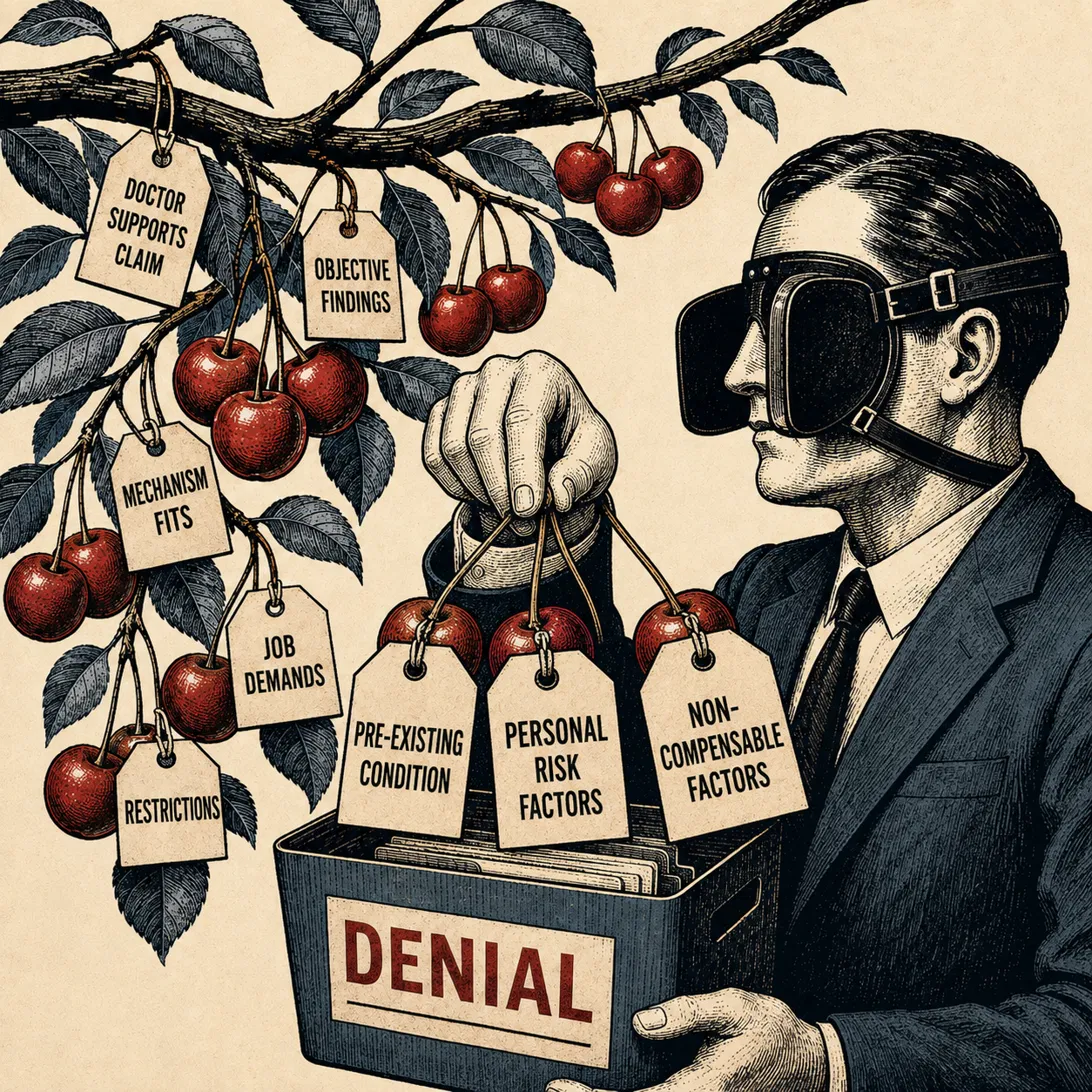
Okanagan cherries are in season, and if you’ve been to a market in the last few weeks you’ve watched people do what people always do. They turn the box, dig past the pale ones, pull out the dark heavy ones and leave the rest behind. Nobody thinks twice about it, because that’s simply how you buy fruit. It also happens to be, more or less, how a contested claim file gets read.
What cherry-picking looks like in a claim
Your file isn’t a story. It’s a thicket of forms, chart notes, medical opinions, a physiotherapy discharge summary and case notes from phone calls you barely remember having, all growing around the same event from different directions. Some of it helps you and some of it doesn’t, and nearly all of it was written in a hurry by people who had no idea which sentence might still matter two years later. Somebody now has to find a path through that thicket and reach a decision, and nobody can give every branch of the record equal attention.
What that looks like in practice is a physiotherapy note recording that you were “progressing well,” which meant your funded block of treatment had run out, turning up in the decision letter while the sentence three lines below it about you still being unable to reach overhead does not. It looks like your surgeon writing that the workplace injury is significant and also noting degenerative changes on the imaging, and you can guess which half gets quoted. It looks like an offhand comment to a walk-in doctor that your back had bothered you “on and off over the years,” by which you meant the occasional stiff morning, becoming a longstanding condition on your file, while the fact that you had never once missed a shift for it in eleven years sits unexamined in an employment record nobody went looking for.
Every one of those quoted facts is true. That is exactly what makes selective reading so difficult to argue with, because nothing has been invented and nobody has lied. The pale cherries were simply left in the box.
The name for what’s happening
The unglamorous name for this is confirmation bias: the tendency to notice, believe and remember whatever fits what you already think, while the things that don’t fit slide past with less attention. It explains far more about your claim than any theory involving bad faith. It isn’t a character flaw and it isn’t rare. It’s how ordinary minds manage more information than they can possibly weigh, and every one of us runs on it, including me and including you.
What makes it matter here is that once somebody forms a working view of your claim, and they form one early because they have to, everything arriving afterward gets sorted against it. Evidence that fits is accepted at face value and filed. Evidence that doesn’t fit gets scrutinized, questioned, and quietly discounted as unreliable or unclear or inconsistent with the rest of the record. Nobody experiences this as bias. From the inside it feels exactly like careful judgment, which is precisely what makes it so hard to see and so hard to argue against.
Why institutions amplify the problem
Confirmation bias is usually described as something that happens inside a single person’s head, which makes it sound correctable. Somebody can be persuaded, or sleep on it, or simply notice they were wrong. In an organization that processes cases it does something worse than that, because there it gets written down, and a file has no capacity to change its mind. Once an early impression is recorded in a case note it stops being somebody’s impression and becomes a fact the next reader inherits. The adjudicator writes that your account of the mechanism seems inconsistent. Three months later a medical consultant reads that note, treats the inconsistency as established, and builds an opinion on top of it. Six months after that, a decision letter cites the medical opinion. Nobody along that chain did anything unreasonable with what they had in front of them, and by the end the original impression has been laundered into a finding through nothing more than repetition.
This is why the first few weeks of a claim matter so much more than they appear to at the time. The earliest documents don’t just describe your claim, they frame it, and every later reader arrives already anchored to that frame. An organization has no mechanism for un-writing something. It only has mechanisms for adding, and additions get read in light of what came before.
Layer onto that the ordinary conditions of the work. Somebody is moving through a queue that never gets shorter, on files that never quite contain the right information, applying a policy manual to situations it was never written for. A sufficiently large claim file will usually contain something capable of supporting almost any working view of the case. There is also an unavoidable institutional reality: claim decisions affect costs, workload and the continuing administration of a file. Nobody needs to issue an improper instruction for those pressures to influence how uncertainty gets approached or resolved.
Whether all of that amounts to structure or to intention matters far less than injured workers tend to believe, because the effect on you is identical either way. What isn’t identical is how you respond. The version of you that arrives at a hearing accusing everyone in the room of corruption is the version that loses, because you’ll spend the hour arguing about motive when the only thing anybody in that room has power to decide is evidence.
The blinders
All of this operates most visibly in one place. When a claim becomes contested, the file often goes to a physician inside the system who has never met you, and there’s nothing improper about that in itself. A doctor can give a perfectly valid opinion on the interpretation of existing medical evidence without conducting an examination, and appeal bodies accept those opinions routinely.
The difficulty is that such an opinion can only be as reliable as the information it was built from, which is the pile and nothing else. If the file carries an assumed timeline, an inaccurate treatment history, or a job description bearing no resemblance to the work you actually did, the internal opinion inherits every one of those errors and then restates them with an authority the original notes never had. From that point onward, later summaries repeat it without anybody going back to check the source. That’s the blinders. Not malice so much as a narrow field of view, and a confident decision made inside it.
So when a decision relies on an internal medical opinion, ask for the opinion itself rather than the summary of it, then read the reasoning underneath the conclusion rather than the conclusion alone. A meaningful share of them rest on a fact that’s simply wrong, and a wrong fact is a fixable problem. What won’t work, and I say this having watched people try it, is arguing that the internal physician never examined you and therefore has no standing to disagree with your own doctor, because appeal bodies are unlikely to set aside an opinion for that reason alone. Beat the reasoning instead of the credentials.
Workers cherry-pick too
The same bias runs in you, and it costs injured workers dearly. You send the three reports that help and quietly leave out the fourth. You describe your worst day as though it were every day. You say you can’t lift anything, when what you mean is that you can’t do the lifting your job demands. You remember with total clarity the phone call where somebody was dismissive, and you’ve forgotten the four calls where somebody was perfectly reasonable, because the dismissive one fits the story you’re already living inside. You leave out the two-week gap before you reported the injury because the reason feels embarrassing, and every one of those omissions eventually surfaces.
When it does, the damage isn’t the fact you left out. It’s that everything else you’ve said now gets read through a different lens, and you’ve handed the file exactly the confirming evidence it was already inclined to look for. The most credible file, uncomfortably, is the one that deals with its own bad evidence out loud and on its own terms. A reporting delay you explained yourself is a detail, while the same delay discovered by somebody else is a credibility problem, and credibility problems spread.
First, check your evidence is even in the box
Everything I’ve described so far assumes the good evidence is sitting there waiting to be noticed. Often it isn’t, and this is the single most useful thing an injured worker can do about any of it.
Order your claim file. Not once, at the point where you’re already in a fight and desperate, but at intervals across the life of the claim, so that you know what’s actually in there while there’s still time to do something about it. Then do the unglamorous work of going through it report by report and checking whether what your own doctors, specialists and therapists actually wrote has arrived.
A surprising amount of the time it hasn’t. Reports get faxed and never scanned. They arrive at a general intake and never get attached to the right claim. A clinic assumes the board requested it directly and the board assumes the clinic sent it. Somebody’s number changed two years ago and nobody updated the form. I want to be careful here, because it would be easy to read this as an accusation of suppression, and most of the time that simply isn’t what’s happening. Documents go astray in every large organization and this one moves an enormous volume of paper. But the consequence for you is identical whether a report was disregarded or never landed at all, because either way an opinion your doctor took the trouble to write is not in the conversation.
I have also watched new medical evidence arrive on a file and then sit there entirely unremarked upon, particularly when it cuts against a position the file has already settled into. Nothing has to be suppressed for that to happen. Evidence that doesn’t fit the working view doesn’t need to be argued with or explained away. It only needs to not be looked at, and a queue of forty files provides excellent cover for not looking.
Confirming a report is on the file isn’t the same as putting it into play. A document nobody has responded to sits there having no effect on anything at all. So once you’ve established that it arrived, ask the next question explicitly and in writing: how does this report affect entitlement on my claim?
That question does two jobs at once. It forces the report to be addressed rather than merely filed, and whatever answer comes back is a decision, which means it’s something you can ask to have reviewed. Silence can’t be appealed. A written answer can, and even an unfavourable one tells you what you’re actually up against, which is considerably more than you had the day before.
How to make your file harder to pick from
Beyond that, you have no control over who reads your file or how carefully, but a good deal of control over how easily it can be quoted against you. Be specific enough that a sentence can’t be lifted out and made to mean something else, because “progressing well” is pickable in a way that “reached 120 degrees of flexion, still unable to sustain overhead work beyond two minutes” is not. Put the unhelpful facts in yourself, with their context attached, before somebody else finds them without it.
Correct errors early and in writing, while they’re still somebody’s note rather than the settled background everybody downstream is relying on. Say what question each document answers when you send it, since a decision-maker with forty files on the go will use whatever’s easiest to find. And when a decision quotes a document at you, get the whole document. A sentence pulled out of a report can point in a very different direction from the report it came from, and I’ve had appeals turn on nothing more elaborate than putting the rest of the paragraph in front of a panel.
None of that stops anyone from reading selectively, because nothing does. What it does is make the selective reading visible, and a decision that has to work around your evidence rather than through the gaps in it is a decision that becomes much harder to defend on appeal.
The thing about cherries
A box of cherries can be picked over without much consequence. A claim file can’t, because the evidence left behind stays exactly as true as the evidence somebody chose, assuming it made it into the box in the first place. If yours has been denied on evidence you know to be incomplete, the useful question was never whether the decision was unfair. It’s which sentence the decision actually turned on, what was sitting immediately next to that sentence, and whether anybody ever put the two of them together. That one is answerable, and it’s usually where the work starts.