
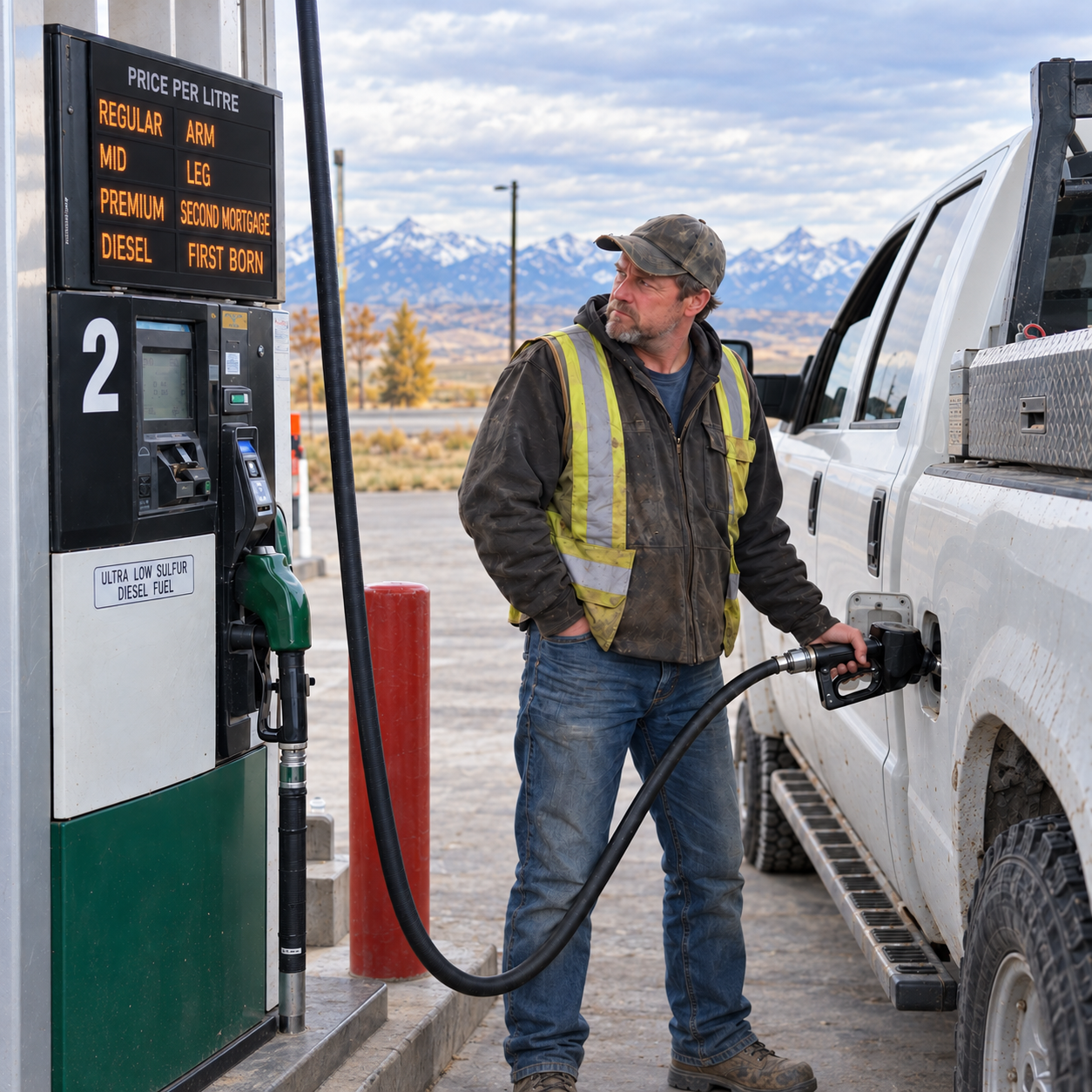
If the price boards at the gas station were being honest right now, regular would cost an arm, mid-grade a leg, premium a second mortgage and diesel your first-born.
I’d laugh harder if diesel weren’t sitting around $2.30 a litre in Alberta and closer to $2.70 across the country. A year ago it was about $1.51. This week the province announced it’s suspending the 13-cent provincial fuel tax from October 1 until the end of the year, because oil has averaged over $90 a barrel for the past month. Since diesel moves pretty much everything we buy, the pump price is only the start of it.
Most working people have some way to adjust when prices climb. They can push for a raise or pick up some overtime. People on a fixed benefit can’t, and that includes most injured workers on long-term WCB benefits. The amount they receive each month stays the same while what it buys keeps shrinking.
The only thing built into the system to deal with that is indexing, the cost-of-living adjustment most boards apply each January. Its purpose is to keep a benefit worth roughly what it was worth when it was awarded. When the adjustment comes in low, or gets denied, the worker has taken a cut. Nobody sends a letter announcing it, so most people never think of it that way.
The Ontario lawsuit
Last week the Toronto Sun reported on an $80-million proposed class action against Ontario’s WSIB. The lead plaintiff, Gordon Polevoy, alleges the board ignored the legislated requirement to index benefits to the Consumer Price Index and used a 24-month averaging method of its own instead.
The year at the centre of it is 2022. Inflation had come in at 4.7%, and WSIB’s method gave injured workers 2.7%. According to plaintiff’s counsel, more than 100,000 workers lost that two-point difference at the start of the year, which for someone earning $1,000 a week works out to more than $1,000 in 2022 alone.
Injured worker groups in Ontario have been fighting this since the 2.7% figure came out. When workers tried to appeal it, they were told the indexing rate couldn’t be appealed. The Divisional Court disagreed in 2023 in Grisales v. WSIB, ruling that the indexing notice was a decision the appeals tribunal could hear. The class action is the next step, and none of its allegations have been proven in court.
To be fair to WSIB, it has an answer. It says its averaging approach is consistent with how the Canada Pension Plan indexes CPP disability benefits. It also says that over the last four years, workers on income replacement actually came out ahead, with total increases of 16.36% compared to 14.89% under the point-in-time method.
I don’t think that settles it, but it does change what the fight is about. Averaging runs behind inflation while prices are going up and catches up once they settle, so workers get less at exactly the point where rising prices hurt most. A worker whose benefits ended before the catch-up years never got the difference back.
Whether WSIB’s formula pays more over four years also doesn’t answer whether WSIB was allowed to use it. When a legislature wants a board to have discretion over indexing, it can say so, and B.C. did. When inflation goes over 4%, WorkSafeBC can set the adjustment anywhere from 4% up to the full CPI change. The plaintiff says Ontario’s Act has nothing like that.
The Alberta version
There’s a related issue here in Alberta that affects a specific group of workers, and we’re arguing it before the Appeals Commission right now.
For a little over two years, from September 1, 2018 to December 31, 2020, Alberta’s Workers’ Compensation Act had no maximum on compensable earnings. Workers injured in that window had their compensation calculated on their actual earnings, however high those were. The maximum came back on January 1, 2021.
Since then, WCB has been denying cost-of-living adjustments to some of those workers on the basis that their original earnings were above the maximum in effect in the year of each adjustment. WCB’s position is that the amended Act and its policy allow it to apply whichever year’s maximum is current when the adjustment is calculated.
We read it differently. Section 59 makes cost-of-living adjustments subject to the “maximum compensation payable under section 56.” For an accident during the no-maximum period, section 56 didn’t impose one. It’s hard to see how a worker can be over a maximum that never applied to their claim, and we don’t read the 2021 amendments as reaching back into that period. The question for the Appeals Commission is whether a later earnings cap can be applied indirectly, through the indexing section, to claims it never applied to directly.
If WCB is right, the consequences are worse than anything in the Ontario case. Ontario workers got a smaller increase that, by WSIB’s own numbers, caught up later. A worker denied COLA under WCB’s interpretation gets no increase at all. Each missed year also gets built into the base that every later year is calculated from.
The numbers add up faster than people expect. WCB’s last three January adjustments were 3.75% in 2024, 2.35% in 2025 and 1.64% in 2026. Compounded, those come to about 7.9%, so a worker who missed all three would be getting nearly 8% more today if they’d been applied. Over a long claim, even at a modest 2% a year, a benefit that never gets indexed loses about a third of its buying power in 20 years.
None of this fall’s price increases are reflected yet either. The 2026 adjustment was set last December, so whatever diesel does to prices this winter won’t show up in a benefit cheque until the next adjustment at the earliest.
Even when WCB does apply the adjustment, it doesn’t fully keep up. Alberta’s formula takes the change in Alberta CPI and subtracts half a percentage point. CPI is also built on an average household’s spending, and injured workers often spend differently, paying out of pocket for medication or for help with jobs around the house they can’t do anymore.
What to do about it
What we’ve asked for in our appeal is pretty basic. WCB should be able to point to the specific wording in the Act that lets it apply a later earnings maximum to a claim from the no-maximum period. It should also be able to show the year-by-year calculations behind each denied adjustment. If that authority exists, it shouldn’t be hard to find.
If you were injured in Alberta between September 2018 and the end of 2020 and your earnings were on the high side, check whether you’ve been getting your COLA each January. If you haven’t, or the increase looks smaller than the published rate, ask WCB in writing how it was calculated and what section of the Act it’s relying on. A denied or reduced adjustment is a decision, and you have one year from the date of that decision to request a review.
That goes for anyone on long-term benefits, really. The January adjustment letter is easy to ignore, but it’s one of the few places where a mistake keeps costing you every year for as long as the claim lasts.
The fuel tax break will take 13 cents off a litre for the last three months of the year. Nothing like that happens automatically for an injured worker whose indexing has been cut off. For those workers the fix has to come through an appeal, and I’ll post an update once the Appeals Commission rules.