
A Warning Every Alberta Worker Over 50 Needs to Read Right Now
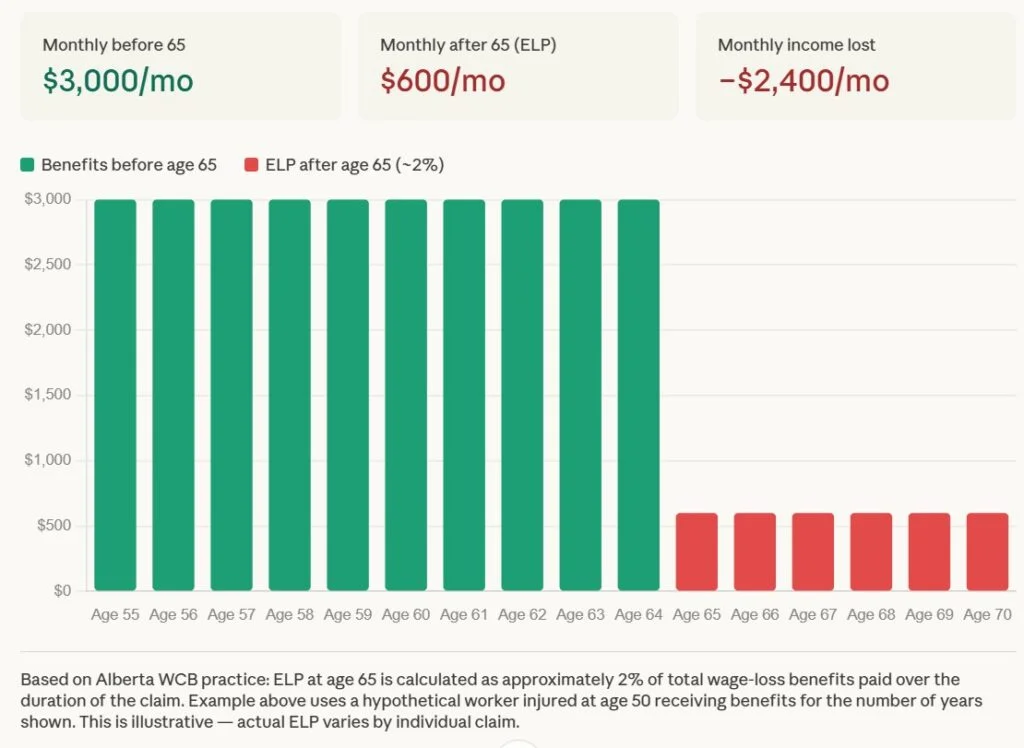
Every week, workers call our office in a state of shock. They’ve been living on WCB benefits, managing their injury, getting on with life — and then, out of nowhere, a letter arrives roughly six months before their 65th birthday informing them that their benefits are about to be significantly reduced.
They didn’t see it coming. Nobody warned them. And in most cases, by the time they call us, they’re in panic mode.
This article exists to make sure that doesn’t happen to you.
What Happens to WCB Benefits at Age 65?
Under Alberta’s Workers’ Compensation Board rules, age 65 is treated as the presumed normal retirement age. When a worker reaches 65, WCB reassesses their entitlement under the assumption that, had they never been injured, they would have retired. The result is a dramatic reduction in ongoing benefits for many workers.
This isn’t a minor adjustment. For workers who have been relying on WCB income as their primary financial support, the cut can be devastating.
The notice WCB sends typically arrives only about six months before the reduction takes effect. For most people, that is nowhere near enough time to prepare, financially or legally.
The One Thing That Can Protect You: Proof of Pre-Injury Intention to Work Beyond 65
WCB does have a mechanism that can preserve your benefits past age 65. If you can demonstrate that — before your injury occurred — you genuinely intended to keep working past 65, WCB may extend your benefits accordingly.
The keyword here is pre-injury. This cannot be stressed enough.
It doesn’t matter what you say now. It doesn’t matter what your family says, what your doctor says, or what seems obvious given your financial situation. WCB will not accept post-injury declarations of intent. Everything — every single piece of supporting evidence — must reflect what your situation and your plans looked like before you were hurt.
What WCB Actually Accepts as Proof
This is where things have gotten significantly harder in recent years. WCB has steadily raised the bar for what it considers acceptable evidence of pre-injury intention to work beyond 65.
It used to be that demonstrating ongoing financial obligations e.g., a mortgage, was often sufficient to establish that a worker needed and planned to continue working. That standard has largely gone away. WCB has become far more demanding, and far more skeptical of after-the-fact financial arguments.
What WCB is now specifically looking for includes:
- A pre-injury letter from your employer confirming that you intended to continue working past age 65 — ideally with specifics about your role, your hours, and the understanding between you and your employer about your continued employment.
- A pre-injury financial plan prepared by a licensed financial adviser that demonstrates, in concrete terms, that your retirement plan was not built around stopping at 65 — that you had mapped out continued employment income as part of your financial future.
These documents carry weight because they were created before the injury, before there was any incentive to say “I was going to keep working.” They reflect genuine, contemporaneous intention.
Why This Matters More Than Ever for Alberta Workers
Let’s be direct about the economic reality most Albertans are living in right now.
Gas is expensive. Groceries are expensive. Housing is expensive. And according to nearly every survey of Canadian financial preparedness, the vast majority of Canadians, and particularly those who have spent years living on reduced income following a workplace injury, have very little saved for retirement. RRSPs that were supposed to grow haven’t. Savings that were supposed to accumulate were spent on surviving.
For many workers approaching 65, retirement isn’t a choice, it’s just simply not financially possible. They need to keep working. The problem is, needing to keep working after the injury is not proof that you planned to keep working before the injury.
WCB doesn’t care what your bank account looks like today. They care what your plans looked like then.
Think of This Like a Will — But for Your WCB Insurance
Nobody wants to think about getting hurt at work. Nobody builds their morning commute around the possibility that today might be the day everything changes. But this is exactly why we make wills. We get life insurance. We take out disability coverage. We plan for things we hope will never happen.
This is the same concept.
If you are a working Albertan who is over 50, and you know in your heart that you cannot afford to retire at 65, then right now — while you are healthy, while you are working, and while it still counts — you should be taking concrete steps to document that intention.
Here is what we recommend:
- Talk to your employer. Have an honest conversation about your plans to continue working past 65. Ask for a letter — even a simple one — that puts on record that you intend to keep working and that your employer is aware of and supports that plan. Keep a copy somewhere safe.
- See a financial adviser. If you don’t have one, get one. Ask them to prepare a financial plan that reflects your real retirement timeline and shows that you’re not planning to stop at 65. This plan should be dated and signed. Keep it with your important documents.
- Do it now. Not when you get hurt. Not when you get the letter. Now. The moment you are injured, the window closes. WCB will only look backwards, and if there is nothing there, there is nothing to find.
If You’re Already on WCB and Approaching 65
If you are currently receiving WCB benefits and your 65th birthday is coming up — whether that is in two years or six months — please contact a WCB advocate or lawyer immediately. The situation is harder to address at this stage, but there may still be options depending on your specific circumstances and what documentation does exist from before your injury.
Do not wait until you receive the letter. By that point, you have very little time and very few tools.
The Bottom Line
Your WCB coverage doesn’t automatically protect you past age 65. That protection has to be earned — and it has to be earned before anything goes wrong. Alberta workers who intend to work beyond the normal retirement age have the right to fight for extended benefits, but that fight depends entirely on proof that was created before the injury ever happened.
A conversation with your employer. A meeting with a financial adviser. A couple of documents filed away with your other important papers. That’s all it takes.
Don’t let a piece of paper you never wrote cost you years of benefits you genuinely needed.
If you or someone you know is approaching 65 and has concerns about WCB benefits, or if you are already on WCB and want to understand your options, contact our office at (780) 340-5727.
We help Alberta workers understand and protect their WCB rights.