
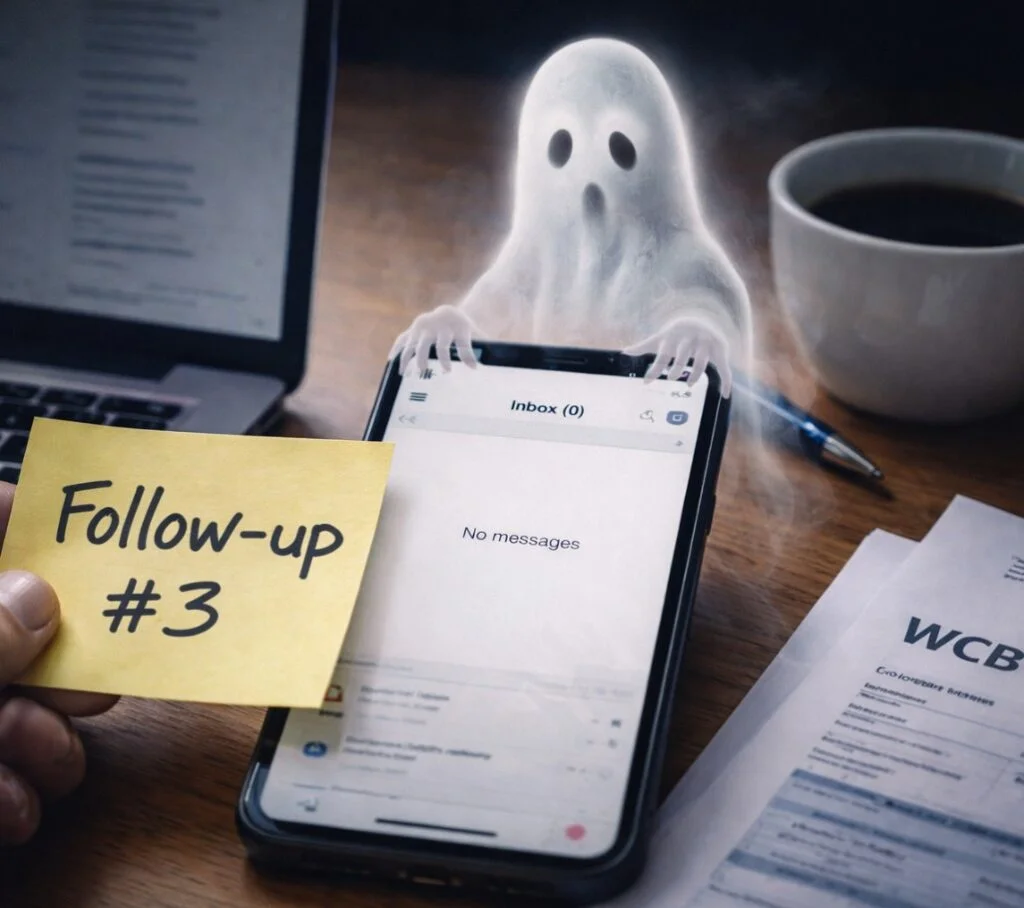
You emailed. You left a voicemail. You followed up. Nothing.
When your WCB case manager goes silent, your claim can stall in ways that cost you real money: wage-loss can be delayed or cut, medical approvals can sit in limbo, and return-to-work planning can drift until your employer loses patience. The worst part is that silence often creates the illusion that nothing is happening—while deadlines keep running in the background.
If you’re dealing with WCB-Alberta, here’s the playbook: stay calm, get specific, put everything in writing, and escalate properly. You’re not trying to “win an argument.” You’re trying to force movement on the file and protect your position if this ends up in review or appeal.
Step 1: Confirm It’s Actually “Ghosting”
Before escalating, make sure you’re not dealing with a simple problem:
-
Your case manager changed (turnover is common)
-
Your email went to the wrong address or bounced
-
You’re using a channel they rarely check
-
Your message is vague (“just checking in”) and easy to ignore
-
You didn’t attach the report/document they need to take action
A practical rule: if you’ve sent two clear follow-ups over 10–14 calendar days with no meaningful reply, treat it as non-response and move to the next steps.
Step 2: Stop Sending “Check-In” Emails—Send an Action Email
Most “ghosting” situations get worse because the worker keeps sending vague follow-ups. You need an email that forces a yes/no response and creates a paper trail.
Here’s a template that works because it’s polite, specific, and time-bound:
Subject: Action Required – Claim #[#######] – Request for Decision/Update re: [Issue]
Hello [Case Manager Name],
I’m following up on my emails of [date] and [date] regarding [specific issue].
To move the claim forward, please confirm one of the following by [date – 5 business days from now]:
-
Your decision regarding [treatment/benefit/entitlement], or
-
What information is outstanding, who is responsible for providing it, and the expected timeline for next steps.
For clarity, the specific request is: [one sentence request—approval/decision/update].
Thank you,
[Your Name]
Claim #[#######] | [Phone] | [Email]
This matters: you’re not asking “how’s it going?” You’re asking for a decision or a specific next step.
Step 3: If No Reply, Follow Up Once—Then Change the Channel
If the deadline passes with no response:
-
Reply to the same email thread with a short message: “Following up as the requested response date has passed. Please advise today.”
-
Call the WCB general line and ask three blunt questions:
-
Is this case manager still assigned to my file?
-
Is there a supervisor or acting adjudicator covering the file?
-
Do the notes show my contact attempts?
-
-
If email seems unreliable, send the same request through a secondary channel (portal/fax). The point is to remove plausible deniability.
If your issue is urgent, say so—briefly and factually:
-
“This is time-sensitive because my medication runs out on [date].”
-
“The surgeon’s booking window expires on [date].”
-
“My employer requires written direction to proceed.”
Step 4: Start a Contact Log (Because This Wins Reviews)
If your case later goes to DRDRB or the Appeals Commission, credibility and documentation matter.
Keep a basic log in your notes app:
-
Date/time
-
Method (email/phone/portal/fax)
-
Who you contacted
-
What you requested
-
What response you got (or didn’t)
If you leave a voicemail, record it:
“Left voicemail at 10:12 a.m. requesting decision on physiotherapy block. No return call.”
This is not paranoia—it’s evidence. WCB files often turn on whether the worker was clear, timely, and reasonable.
Step 5: Escalate Cleanly (Without Melting Down)
Escalation is not a tantrum. It’s a process.
If you’ve made reasonable attempts and still have no response, escalate to a supervisor or team email—calmly, with dates.
Subject: Escalation Request – Claim #[#######] – Ongoing Non-Response on Time-Sensitive Issue
Hello,
I’m requesting assistance due to ongoing non-response from the assigned case manager.
I contacted the case manager on:
-
[date] – email re: [issue]
-
[date] – follow-up email
-
[date] – voicemail
The matter is time-sensitive because [brief reason]. Please provide either:
-
a written update/decision, or
-
confirmation of what information is outstanding and the expected timeline.
Thank you,
[Your Name]
Claim #[#######]
Don’t over-explain. Don’t vent. Keep it boring. Boring wins.
Step 6: Protect Your Review and Appeal Deadlines (Even If WCB Is Silent)
This is where people get burned.
If you received a decision letter (denial, benefits ended, “recovered,” treatment refused, etc.), assume there is a time limit to challenge it. WCB’s silence does not necessarily pause the clock.
If you’re nearing a deadline and still waiting for clarity:
-
file the review/appeal out of an abundance of caution, and
-
state clearly: “This is filed to preserve timelines while I await the requested information.”
You can always refine submissions later. You can’t resurrect a missed deadline without begging for an extension.
Common Ghosting Scenarios and the Questions to Ask
Most silence happens around predictable flashpoints:
1) Wage-loss suddenly stops
Ask for:
-
the written rationale
-
what medical evidence they relied on
-
whether an internal medical consultant was involved
-
what functional abilities they believe you have
2) Treatment delayed/denied (physio, injections, surgery)
Ask for:
-
a written decision
-
what information is “outstanding”
-
whether it’s being sent for internal medical review
-
the expected timeline for decision
3) Return-to-work pressure and “suitable work” disputes
Ask for:
-
written confirmation of accepted restrictions
-
the job demands they’re relying on (if applicable)
-
why they consider the role suitable
What NOT to Do (If You Want Results)
-
Don’t spam daily “just checking in” emails.
-
Don’t rant or threaten the media, politicians, or lawsuits.
-
Don’t rely on phone calls only—if it’s not written, it didn’t happen.
-
Don’t make claims you can’t prove (“you’re ignoring me on purpose”). Stick to dates and facts.
Bottom Line
When your WCB Alberta case manager is ghosting you, your job is to force the file forward and build a record that holds up under review.
Be polite. Be specific. Put deadlines in writing. Change channels. Escalate cleanly. Protect your timelines.
If you’ve done all of the above and you still can’t get traction, that’s usually the moment to consider representation—because delays quietly become denials, and denials become appeals.
Need help getting your file moving?
Contact us here
FAQS
1) How long should I wait before escalating to a supervisor?
If you’ve sent two clear follow-ups over 10–14 calendar days with no meaningful reply (and the issue is affecting benefits or treatment), escalate calmly with dates.
2) Will escalating make my case manager retaliate?
A professional escalation that sticks to facts is normal and appropriate. The key is to stay unemotional, precise, and respectful.
3) Should I call or email WCB?
Do both. Calls can clarify assignment and coverage, but email creates the paper trail that matters later.
4) What if my benefits are cut off and nobody answers?
Treat it as urgent. Request a written decision and rationale immediately, and protect deadlines by filing review/appeal steps “out of an abundance of caution” if time is running out.
5) Is it better to ask for a decision or just an update?
Ask for a decision or a clear list of what’s outstanding with timelines. “Updates” are easy to dodge. “Decision or next steps by X date” is harder to ignore.