
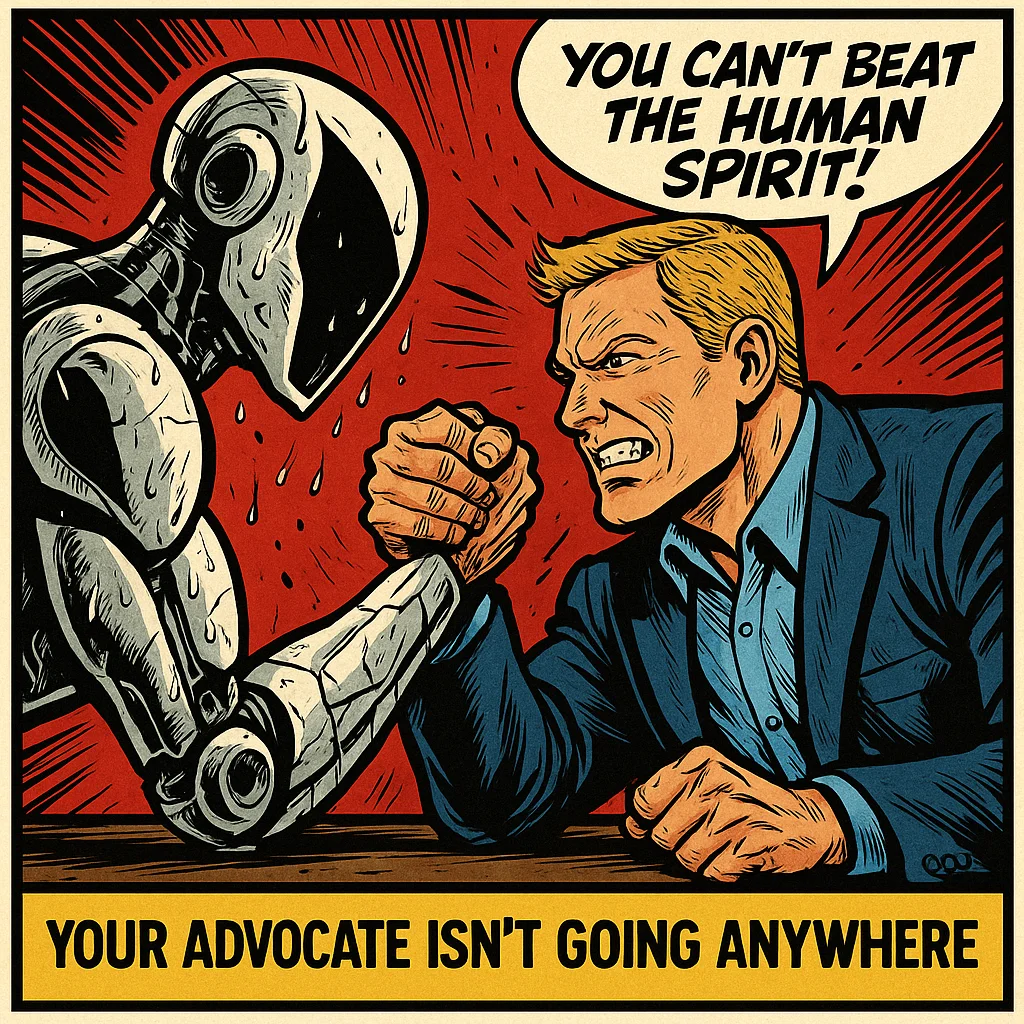
Why the robots can’t replace the humans fighting for your workers’ comp claim
Maria Gonzalez thought she was losing her mind. After fifteen years cleaning office buildings, her shoulders screamed every time she lifted her arms above her head. Her doctor said it was work-related. Her physiotherapist agreed. The MRI showed torn rotator cuffs in both shoulders. But Workers’ Compensation Board said no. Computer says no, essentially.
Three months later, Maria’s advocate had her claim approved. Same medical evidence. Same injury. Same bureaucracy. So what changed?
The difference wasn’t the facts—it was the story.
The Fear
Everywhere you look, artificial intelligence is eating jobs. Chatbots answer customer service calls. Algorithms trade stocks. AI writes news articles and diagnoses diseases. So when injured workers hear that computers can now summarize medical reports and draft legal documents faster than any human, a reasonable question emerges: Is my advocate next?
The short answer is no. But the long answer is more interesting and nuanced.
What Computers Do Best
Picture a vast library containing every Workers’ Compensation Board policy, every court decision, every medical journal article about workplace injuries. Now imagine someone who can read that entire library in minutes, cross-reference everything, and spit out summaries on command. That’s basically what AI does now.
Need to know what Policy 03-02 says about pre-existing conditions? AI’s got it. Want to compare how different provinces handle psychological injury claims? Done in seconds. Looking for recent Appeals Commission decisions about chronic pain? Here’s your comprehensive list, sorted by date and relevance.
This is revolutionary for the grunt work of legal practice. The hours advocates used to spend digging through policy manuals and case law databases can now be compressed into minutes. Documents get organized automatically. Deadlines get tracked. First drafts of standard letters appear with a few keystrokes.
But here’s what the efficiency gains miss: Workers’ comp cases aren’t won in policy manuals. They’re won in the spaces between the rules.
The Human Story
Back to Maria. The AI summary of her file was technically accurate: “52-year-old custodial worker presenting bilateral shoulder impingement, MRI showing degenerative changes consistent with repetitive overhead motion, seeking coverage under repetitive strain injury provisions.”
Her advocate saw something different: “Maria raised five kids while working two jobs, including fifteen years of reaching overhead to clean ceiling fans, high windows, and light fixtures in a city where most office buildings were designed by architects who apparently never cleaned anything themselves.”
Same facts. Different frame. The frame matters because workers’ comp decisions aren’t made by computers, but rather they’re made by humans who respond to stories as much as statistics.
The Contradiction Game
Every denied claim contains contradictions. The trick is knowing which ones matter.
Take the independent medical examination—the dreaded IME that workers know is rarely independent and usually hostile. AI can spot when an IME doctor contradicts himself between page three and page seven of his report. But it takes human judgment to know that the real contradiction isn’t internal to the report—it’s between the doctor’s conclusion and the sixteen photographs of the workplace that show the impossible ergonomics the worker faced daily.
Or consider the employer who claims no light-duty work exists for an injured employee, while simultaneously posting job openings for positions that perfectly match the worker’s restrictions. AI can flag this inconsistency. But a human advocate knows when to deploy it like a surgical strike versus when to hold it back for maximum impact at a hearing.
The computer finds the discrepancies. The human weaponizes them.
The Trust Factor
Here’s what no algorithm can replicate: sitting across a Formica table at Tim Hortons while a 45-year-old electrician breaks down describing how he can’t pick up his grandson anymore.
Workers’ compensation claims happen to real people having the worst time of their lives. They’re in physical pain. They’re financially desperate. They’re scared about their future. They’ve been treated like liars by bureaucrats who’ve never done physical work a day in their lives.
They don’t just need someone who understands Policy 04-01. They need someone who believes them. Someone who gets angry on their behalf. Someone who can translate their lived experience of disability into language that bureaucrats can’t ignore.
You can’t download empathy. You can’t program righteous indignation. You can’t algorithm your way into the kind of trust that makes a client comfortable enough to tell you about the panic attacks they’ve been hiding, or the marriage that’s falling apart because chronic pain has changed who they are.
Reading the Room
Workers’ comp hearings are theater as much as law. The panel members—usually lawyers, doctors, or other professionals—sit behind a long table while the injured worker sits in a single chair, often without even a desk to rest their papers on. The power dynamic is intentional and intimidating.
An experienced advocate reads this room like a poker player reads tells. Is the chairperson checking their watch because they’re behind schedule, or because they’ve already made up their mind? Is the medical member leaning forward because they’re engaged, or because they’re skeptical? When the employer’s lawyer objects, is it strategic positioning or genuine concern?
These micro-observations shape macro decisions. Push harder on this point. Back off on that one. Adjust the tone. Change the approach. Real-time tactical decisions based on human cues that no artificial intelligence can process.
The Bureaucratic Maze
Workers’ Compensation Boards are massive bureaucracies with personalities as distinct as small nations. Alberta’s WCB operates differently from Ontario’s WSIB, which operates differently from BC’s WorkSafeBC. Each has its own culture, its own blind spots, its own internal politics.
More importantly, each individual case manager, medical advisor, and appeals officer brings their own biases, experiences, and pet peeves to the process. Some respond to detailed medical arguments. Others want simple human stories. Some are impressed by extensive legal research. Others are annoyed by it.
AI can tell you what the official process says. But it takes years of practice to know that Case Manager Johnson tends to approve psychological claims more readily than Case Manager Smith, or that Appeals Officer Chen always asks about pre-existing conditions even when they’re not relevant.
This institutional knowledge isn’t written down anywhere. It’s accumulated through hundreds of conversations, dozens of hearings, and countless informal interactions with system insiders. It’s the difference between knowing the rules and knowing how the game is actually played.
The Dirty Work
Nobody talks about this part, but advocacy often involves detective work that would make Philip Marlowe proud. It’s calling the employer three times to get surveillance footage they claim doesn’t exist. It’s spending two hours on the phone with a confused foreign medical graduate who examined your client to understand what his broken English report actually means. It’s driving to your client’s workplace at 6 AM to take pictures that show what the lighting actually looks like during the shift when the accident happened.
It’s tracking down the co-worker who witnessed the incident but moved to Saskatchewan. It’s finding the supervisor who made the safety decision that caused the injury but has since been promoted and doesn’t want to talk. It’s obtaining twenty years of employment records to prove that your client’s back problems started exactly when the job requirements changed.
This isn’t glamorous work. It’s time-consuming, often frustrating, and requires human skills like persuasion, persistence, and the ability to make people want to help you. AI can’t charm a reluctant witness into talking. It can’t convince a former supervisor to testify against their old employer. It can’t build the kind of relationships that make people return phone calls.
The Strategy Layer
Every workers’ comp case involves choices: Which medical expert to hire. Which legal arguments to emphasize. Whether to settle or fight to the end. Whether to focus on the original injury or the employer’s failure to accommodate. Whether to make this about medical causation or workplace safety violations.
These decisions can’t be made by consulting a database or following a flow chart. They require judgment calls based on incomplete information, assessment of risks and benefits, and understanding of how this particular client’s personality and circumstances interact with this particular system’s tendencies.
An AI might calculate that similar cases succeed 73% of the time when they emphasize medical causation versus 68% when they focus on accommodation failures. But it can’t factor in that this client becomes visibly angry when discussing workplace safety—anger that might alienate a conservative appeals panel—or that the employer in this case has such a terrible safety record that accommodation arguments play into a larger narrative of corporate indifference.
What This Means for You
If you’re an injured worker navigating the workers’ compensation system, here’s what the AI revolution actually means:
Your advocate is about to get a lot more efficient. The time they used to spend on research and document preparation can now be focused on strategy, relationships, and advocacy. They can handle more cases without cutting corners on the human elements that matter most.
The bureaucrats processing your claim are also getting AI tools, which might speed up routine decisions but won’t change the fundamental human judgment calls that determine outcomes in complex cases.
Most importantly, the essential dynamic hasn’t changed: You still need someone in your corner who understands both the system and your story, who can navigate bureaucratic mazes and build human connections, who gets angry about injustice and knows how to channel that anger productively.
The Irreplaceable Human Element
Maria’s case got approved not because her advocate had access to better technology, but because he understood something fundamental about workers’ compensation: It’s not really about medical evidence or legal precedents, though those matter. It’s about convincing another human being that this particular injured worker deserves help from this particular system at this particular moment.
The advocate took Maria’s scattered medical appointments, her inconsistent work history, her limited English, and her visible frustration with the system, and turned it into a story that appeals officers could understand and relate to: A dedicated employee who literally reached too high for too long because that’s what the job required, until her body couldn’t reach anymore.
That’s not just legal skill. It’s human artistry. And it’s exactly what artificial intelligence can’t replicate.
The robots might be coming for a lot of jobs. But they’re not coming for the humans who fight for workers when the system fails them. Because in the end, workers’ compensation isn’t about algorithms and policy manuals.
It’s about people. And people need other people in their corner.
Your WCB advocate isn’t going anywhere.