
What a little machine on my desk says about your chances of winning a WCB appeal
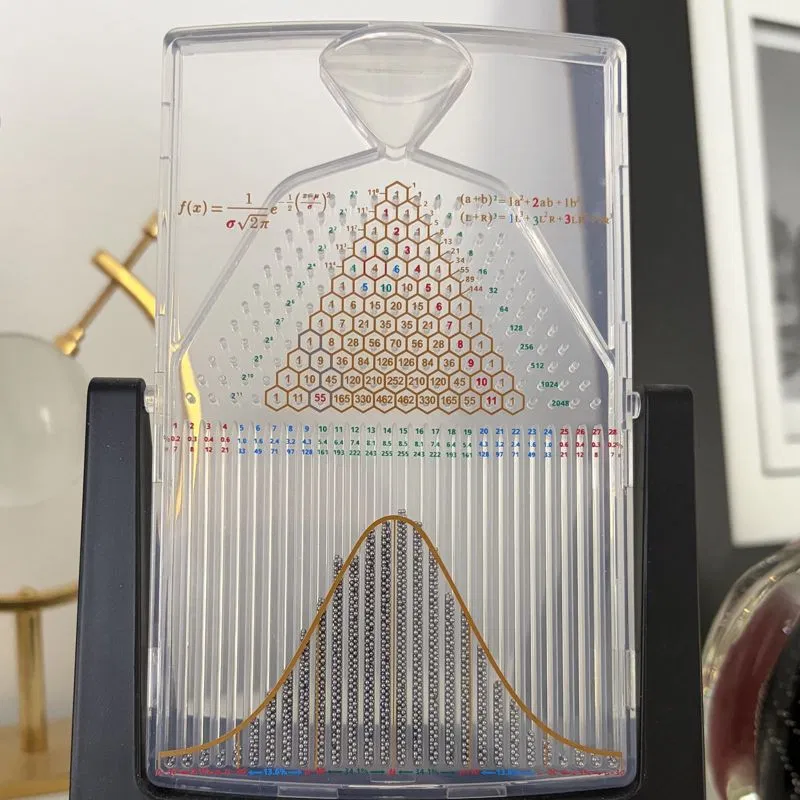
There’s a Galton board on my desk. It’s a clear panel with rows of pegs and thousands of tiny steel beads sealed inside. Flip it over and the beads tumble down through the pegs, bouncing left and right until they settle into narrow slots at the bottom. Try to follow a single bead and you’ll lose it in the crowd within a second or two. The pile at the bottom, though, comes out roughly the same way every time, a bell curve that’s high in the middle and low at the edges. I find it oddly comforting that all that chaos still settles into a pattern.
Now imagine one of those beads is yours, and where it lands decides whether your mortgage gets paid or whether you’re sent back to a job your body can’t handle anymore. You’d watch the board a lot differently. The nice bell curve at the bottom wouldn’t interest you much. You’d be watching your bead.
The board gets something right about workers’ compensation. WCB handles enough claims to think in statistics and averages, but an injured worker lives through their own claim, and the consequences follow them home. So when someone asks me about their chances of winning a WCB appeal, there’s usually a more personal question sitting underneath it. Is there still a way through this, and can I afford to keep trying? That deserves a better answer than an encouraging guess.
Every peg is a person
Every claim passes through a lot of hands. Someone takes down the first account of the injury, and someone else decides which medical questions need answering. Your doctor describes your restrictions and WCB’s medical consultant interprets them. Add the physiotherapists, occupational therapists, specialists and radiologists WCB contracts with, each reading your body a little differently, and the hands multiply quickly. Then somebody weighs what’s on the file and makes a call. If you dispute it, someone further down the line decides whether that call was sound.
Each of those hand-offs is a chance for the picture to get clearer, and a chance for something to get missed. I’ve watched it happen on file after file. A passing comment from a ten-minute appointment gets repeated from report to report until it reads like established fact. A worker tries to stay upbeat with their doctor, and that optimism lands on the file as proof they’re getting better. Meanwhile the worker keeps trying to explain that the person on paper doesn’t look much like the life they’re actually living.
This is where the board starts to feel familiar. A small bounce early on can send a claim somewhere nobody intended. By the time a worker reaches an appeal, they may be arguing with a version of themselves that took shape months earlier, without being quite sure how it got there. It’s one of the best reasons I know to get advice early, before that version hardens.
There’s also plain luck involved, and any honest talk about your chances has to admit it. Some people read a file carefully and are willing to rethink an assumption. Others are buried in files and slow to let go of a first impression. In a backlogged system, even the careful ones are working against the clock. You don’t get to pick who handles your claim, and no amount of preparation removes that uncertainty. So a denial doesn’t, on its own, prove your injury isn’t real or that your concerns aren’t reasonable. Sometimes your claim just hit the wrong peg.
Where the board stops being useful
The board only gets you so far, though. A WCB decision is supposed to rest on evidence and the rules that apply. A medical report isn’t a coin toss, and a hearing isn’t another random bounce. Some evidence matters far more than the rest, and one well-reasoned opinion that answers the disputed question can change how everything else on the file gets read. That’s where a good advocate earns their keep.
What influencing the outcome actually looks like
Say your doctor has written that you’re unable to work. You read that and, understandably, figure the medical evidence is settled. The real dispute, though, might be whether your accepted injury stops you from doing particular duties, or whether you could keep doing them through a full workweek. “Unable to work” gives your doctor’s conclusion without the reasoning behind it, and the reasoning is usually what settles a disagreement like that.
So the next step might be asking your doctor to answer those questions directly. Doing that well means understanding both the medicine and the decision you’re challenging. It also takes care. What you want is the doctor’s own honest opinion, including whatever they’re unsure about, and not a report that says what we’d like it to say. Decision-makers can tell the difference, and a report that shows its reasoning gives them something real to weigh.
Other times the evidence you need is already on the file, buried somewhere in hundreds of pages and nowhere near the question it answers. One report describes how your attempt to return to work went. Another records how long it took you to recover afterward. Read together, they can show why doing a task once isn’t the same as doing it day after day for a paycheque. Drawing that connection clearly can do more for your appeal than another hundred pages ever would.
We don’t have control, but we have influence
It’s the most honest way I know to describe what we do. Lean a Galton board even slightly and the whole pile shifts without a single peg moving. In a claim, that influence comes from making sure the evidence is understood and the right questions get answered. I can’t promise where your claim will land. What I can do is work out what the decision really turns on and whether the evidence actually supports it. Then I make sure your side of it gets the clearest and strongest presentation the facts allow.
That work doesn’t always turn up good news. Often it uncovers a solid argument, or a gap we can fix. Sometimes it confirms that the case is a hard one and there isn’t much left to strengthen it. Either way, you deserve to know before you put more money and hope into it.
Your chances of winning a WCB appeal
My team and I currently represent close to 700 clients, so I’ve watched a lot of beads fall. That experience tells me how cases like yours tend to go. It can’t tell me exactly where yours will land, which is why I’m careful with percentages. A number sounds precise, but it explains almost nothing about your particular case.
Before I can give you a useful read, I need to understand why the decision was made and what evidence points the other way. Then I need to think about what could realistically change. Unlike the board, a claim’s conditions keep shifting while it’s still falling. A new case manager takes over, or a new diagnosis changes what everyone thinks they’re looking at, so a good assessment gets revisited as the file develops. “There’s a strong argument here, but this medical question needs answering” is something you can act on. I’d much rather tell you what makes your case strong or vulnerable than hand you a percentage I can’t back up.
When you’ve already lost twice
By the time some workers consider taking their case to the Appeals Commission, they’ve already been told no twice: first by WCB when it made the decision, and then by WCB’s Dispute Resolution and Decision Review Body, usually shortened to DRDRB, when they challenged it. The Appeals Commission is a separate appeal body outside WCB, where they can challenge the DRDRB decision.
Those two losses can flatten you, especially when you feel you’ve explained yourself as clearly as anyone could. It’s understandable to wonder what another appeal could possibly accomplish. Two denials don’t make you due for a win, but they don’t automatically make an appeal to the Commission hopeless either.
What those losses can do is tell us something, if we read the reasons instead of counting the defeats. Did the same assumption get carried forward from one decision to the next? Was the evidence pointing the other way ever properly dealt with? If there’s a credible basis for a different result, it usually shows up in the answers to those two questions.
An appeal needs a purpose you can understand. Before you file, you should know exactly which decision you’re challenging and what you’re asking the next decision-maker to do about it. The outcome will still be uncertain, but you’ll be making the call with your eyes open.
Following one bead
Left alone, the board on my desk will keep turning out roughly the same bell curve every time I flip it. But once you’ve pictured your own life riding on one of those beads, it’s hard to go back to admiring the overall shape. You want to know where yours went and whether anything can still be done about it. Your claim deserves that kind of attention.
If you’re wondering whether your WCB decision is worth challenging, talk to us before you decide. Blue Collar Consulting can help you understand where your case stands and whether there’s a sensible path forward. Your first consultation is free. Call us at 780-340-5727.