Why Softening Society Fails the People Who Face Reality Head-On
The Lunk Alarm Syndrome
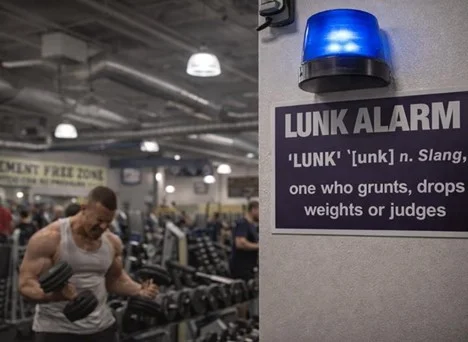
Recently, between sets of dumbbell curls, I counted the moralizing messages festooned across the walls of my local fitness club. Don’t judge. Judgment-Free Zone. Leave your ego at the front door. Staff members even wield a siren, the infamous ‘Lunk Alarm,’ to be deployed if I grunt too loudly, drop a weight, or otherwise appear insufficiently humble. And perhaps it’s a good thing, because I often feel an irresistible urge to parade shirtless around the place, savagely judging waistlines, slicing self-esteem like a deranged Teppanyaki chef. But the Lunk Alarm, in its wisdom, stands ready to prevent me from unleashing those lewd and obnoxious proclivities on an unsuspecting public.
Jokes aside, the Lunk Alarm is a symptom. We’ve trained ourselves to avoid discomfort while outsourcing reality to first responders—the police officers, paramedics, and firefighters who handle what the rest of us won’t look at. I’ve seen the consequences of that mismatch for years in WCB advocacy.
In this advanced and decadent age, we’ve become preoccupied with sanding down the sharp edges of a cruel universe. It’s done with the best of intentions. Rose-coloured glasses have their uses. The irony is that these efforts often backfire: the more our tender sensitivities are coddled, the softer we become, and the more defenseless we are against the slings and arrows of outrageous fortune. Yet the unintended consequences never deter us. The contortion of language continues unabated, allowing only oblique references to the unsavory sides of life, as though a new label could change the thing itself.
Divorce becomes ‘conscious uncoupling.’ Suicide becomes ‘passed away by self-harm.’ Homelessness becomes ‘outdoor urban dwelling.’ We stack challenge after challenge—vertically-challenged, follicularly-challenged, motivationally-challenged—as though the suffix could cushion the blow. Even nature videos now require trigger warnings. A lion eating a zebra is no longer just biology. It is “graphic content,” and you are meant to proceed with caution.
First Responders Don’t Get Euphemisms
As a WCB representative advocating for first responders across Western Canada, I’m struck by the gap between how polite society sanitizes uncomfortable truths and how first responders meet reality head-on—no euphemisms, no warnings, no alarm to sound when the scene gets too ugly. They live in the world of the concrete, not the abstract. No amount of doublespeak, sensitivity jargon, or curated language shields a police officer from mass hemorrhage, drug overdose, fatal collisions, homicide, or child sexual assault. While the rest of us sleep soundly in our beds, somewhere a first responder has a thumb on an artery, or is pounding out chest compressions, trying to keep a stranger alive. They willingly step into the terror of existence so someone else might get one more day of it.
Many of these people call me after fifteen years or more of service. This job has a shelf life. The human nervous system has a lifetime limit for trauma exposure—what researchers call cumulative stress injury—and even the most stoical, well-adjusted person can only metabolize so much horror before something
fundamental gives. Week after week, year after year, intense exposures accumulate until something breaks. For many, the result is not “stress” in the casual sense, but a genuine and disabling mental injury. And, sadly, a great number of them only find me after WCB has already denied their claim. Sometimes the rationale is that exposure to trauma is “normal” for a first responder, as if routinely encountering dead and mangled human bodies, screaming victims, and life-or-death chaos could ever be normal in any meaningful human sense.
Calling it “normal” does not make it benign. It only makes it easier to dismiss.
How We Get Claims Accepted
When they do find Blue Collar, we’re often able to get their claims accepted. The method is simple, and it’s the very opposite of the cultural habit I’ve been mocking. We describe what happened in plain language. We name the scenes: the body parts, the blood volume, the sounds, the smells. We stop trying to make horror sound polite. We write it raw, unvarnished, and specific—even if it makes the claim adjudicator uncomfortable. Trauma does not arrive as an abstraction, so it cannot be proven as one. But acceptance is only the first battle.
The Return-to-Work Machine
The next is treatment, and here the incentives become obvious. WCB wants intensive therapy, quickly, and with an implied destination. In some cases, that helps. Some first responders genuinely benefit from processing their exposures, learning coping mechanisms, and regaining a sense of internal control. The problem is not therapy itself. The problem is the aim. The goal should not be “return-to-work” as fast as possible. It should be return-to-life. For a significant subset, PTSD is so severe that they can barely step outside their front door, let alone put on a uniform and walk back into the same machinery that broke them. Yet “graduation” often means precisely that. It becomes a race to functional appearances, not a careful reckoning with what the person can actually tolerate.
And in many cases the condition is complex and treatment-resistant, not because the worker is weak, but because the exposures have been relentless. Decades-long contact with the worst of reality is not a single incident to be filed, processed, and resolved. It is cumulative moral injury, cumulative grief, cumulative shock, until the mind’s protective mechanisms finally fail. Here is the bitter irony that polite slogans never mention: the most devastated are often the best ones. The compassionate. The conscientious. The introspective. The people with strong empathy and strong internal standards—exactly the traits you want in a first responder. They absorb more. They notice more. They carry more.
And when those people finally break, it’s not always because they ‘didn’t talk about it enough.’ Sometimes the repeated excavation is the injury. Sometimes forcing traumatic memories into constant daylight isn’t healing— it’s re-traumatization. To be clear: trauma-focused therapies like EMDR and CPT have strong evidence bases, and many first responders genuinely benefit from them. Talking gives shape to chaos, shares the burden, and restores agency. But when a worker is not responding, when the treatment is destabilizing, when it is triggering and counterproductive, WCB too often keeps pulling the same lever anyway. The machinery does not like exceptions. Policy is policy. The procedures rule over common sense. And the person, the actual human being living with the terror, becomes secondary to the administrative need for a tidy narrative: treatment completed, function restored, worker returned.
When Treatment Becomes Endurance Training
What do I mean when I say WCB “doesn’t care” as an institution? I’m not talking about individual adjudicators or case managers—many of whom genuinely want to help. I’m talking about the machine itself, which has a single, overriding purpose: return-to-work. Not “return-to-life.” Not “return-to-stability.” Return-to-work. Full stop. And once you understand that, much of the Board’s behaviour stops looking confusing and starts looking inevitable. Even when the writing is on the wall for a veteran first responder who has tried everything from CBT to EMDR to group therapy, exposure work, and every other acronym in the clinical alphabet, the demand is often the same: more. More sessions. Another program. Further interventions. More proving. At a certain point you start to wonder what, exactly, is being administered. Is this therapy, or endurance training? Is it compassionate treatment, or a bureaucratic stress test designed to measure how long a broken person can survive in the grinder before they stop filing claims?
And when treatment becomes effectively interminable, when it is imposed as a condition of continued benefits, when it requires repeated re-entry into the worst rooms of the mind, it begins to resemble something darker. I sometimes find myself asking whether the Board is pushing people toward the breaking point rather than accepting the obvious reality that some are permanently harmed. For certain veteran first responders, “just keep going to therapy” becomes a substitute for acknowledging permanence. It delays the conclusion the evidence is already pointing to. It keeps the file in motion. It avoids the moral and financial weight of declaring someone permanently disabled. But from the worker’s side of the table, it can feel like punishment dressed up as care.
The Point: Return-to-Life
None of this is to say reasonable efforts shouldn’t be made. They absolutely should. Injured workers deserve support, stabilization, and access to high-quality mental health treatment that’s actually tailored to their response. The point is that veteran first responders are not dealing with a single bad day. They cannot unsee and unexperience decades of horror. For many, what they need is not perpetual excavation. They need closure. They need permission to stop. They need the dignity of acknowledging that some chapters do not “resolve,” they end.
In my work, I see what happens when WCB follows the same instinct: soften the language, normalize the horror, and then act surprised when the human mind won’t cooperate. The same pattern shows up beyond psychological injury. In physical claims, the vocabulary changes, the timelines harden, and rehabilitation
becomes less a support than a command. “Graduation” becomes an administrative requirement. “Function” becomes a number. “Participation” becomes a condition. And when a worker’s lived reality refuses to conform, WCB reaches for the same lever again—one more program, one more plan, one more round of proving—not because it’s clearly helping, but because motion defers liability. Pushing rehab is easier than accepting permanence. Demanding one more attempt is easier than admitting the person will never return to what they were.
If you’ve lived this, or if someone close to you has, the first thing to understand is that you aren’t crazy for feeling steamrolled. The system is built to move files forward, and it will often interpret resistance as non- compliance rather than as a symptom, a limitation, or a warning sign. In those moments, it helps to have someone in your corner who knows how the language works, how decisions are really made, and how to force the file back onto what should have been the point all along: the actual human being. Not a slogan on a wall. Not a program metric. Not a preferred narrative. A person.
If this sounds familiar—if you’re a first responder whose PTSD claim was denied because trauma exposure is “normal for the job,” or if you’re being pushed through endless treatment programs that destabilize rather than heal you—contact Blue Collar. Not to fight the system for sport, but to force it to deal honestly with reality. To make sure your return is a return-to-life, whether or not it ever becomes a return-to-work.