
Why Claims Are About More Than Just Knowing the Rules
Somewhere in the first conversation I have with a new client, usually after I’ve heard the basic shape of what happened to them, I’ll say something that on the wrong day, in the wrong ear, could land very badly.
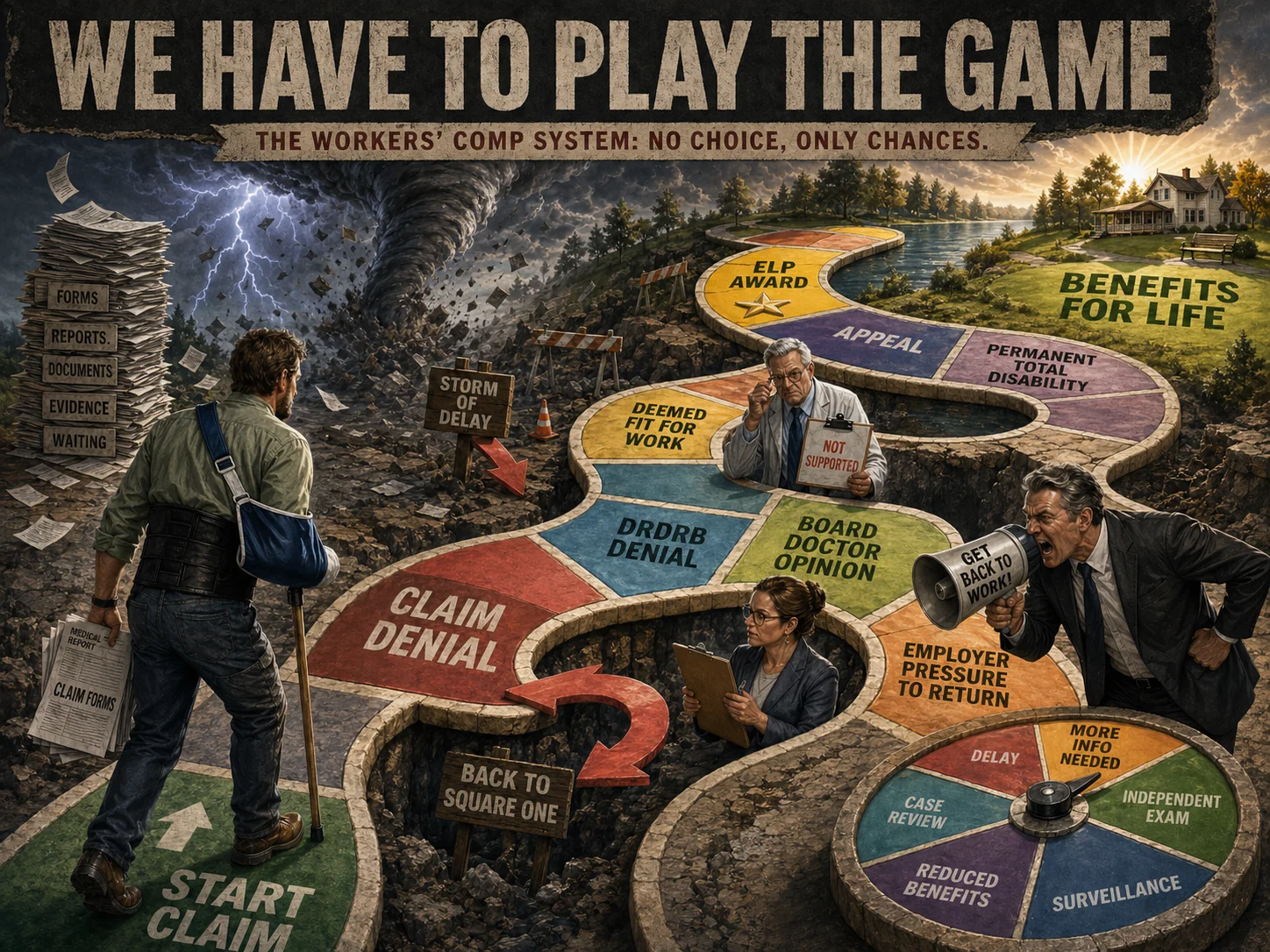
I’ll say: we have to play the game.
I cringe every time I hear myself say it, because I know what it could sound like. It could sound like I’m calling someone’s surgery, their lost wages, their wrecked back, their marriage that’s straining under all of it, a game, as if to reduce their pain and suffering to Trivial Pursuit. It’s the opposite of what I mean. The reason I keep using the phrase, after nearly a decade of doing this work, is that it’s the most honest sentence I have. Pretending otherwise would be mincing words. The phrase isn’t a confession of cynicism. It’s a confession that the system isn’t quite what it claims to be, and that pretending it is the thing it claims to be is the most dangerous mistake an injured worker can make.
This article is my attempt to explain what I actually mean.
A Quote That Has Nothing and Everything to Do With WCB
I want to start somewhere unexpected, with a passage by R.D. Laing. Laing was a Scottish psychoanalyst, sometimes a philosopher, often a provocateur, one of the stranger and more interesting minds of the twentieth century. He wrote a slim book called Knots that maps the small impossible binds people get caught in inside their closest relationships. One of the knots reads like this:
They are playing a game. They are playing at not playing a game. If I show them I see they are, I shall break the rules and they will punish me. I must play their game, of not seeing I see the game.
Read it twice. It rewards a second pass.
Laing was writing about families and lovers and the quiet little cruelties that build up between two people over years. But change a word here and there and he might as well be describing what it is to be a worker, or a worker’s representative, sitting across the table from a Workers’ Compensation Board.
The Recursive Bind
What Laing is naming is a particular kind of trap. There’s a game going on. Everyone playing it has agreed, without saying so, to act as though there isn’t. The agreement to pretend is part of the game. And here’s where it gets interesting: if you point at the game and say “we are playing a game,” you don’t end the game. You break a rule. And breaking the rule has consequences.
You can spend a lifetime in a relationship like that and never quite figure out why every conversation feels slightly wrong. You can also spend a long career inside an institution like that and never quite figure out why your good-faith arguments keep falling on deaf ears.
The trick of it is that the silence about the game is the most important rule in the game. The system needs you not to see what it actually is, in order to keep being what it claims to be.
What the Law Actually Is
Most people, when they think about the law, think of it as a set of rules. There is a Workers’ Compensation Act. There is a policy manual. The rules are written down. You read the rules, you understand the rules, you apply the rules, you get an outcome. If the outcome seems unfair, well, the rules are the rules.
This is a comforting picture, and it isn’t entirely wrong. There are rules. They do constrain outcomes. But after enough years inside a legal system, you start to notice that the picture is incomplete in some important ways.
What you start to see is that law isn’t quite a set of rules in the sense we mean when we talk about, say, the rules of chess. It looks more like a process for making decisions in contested human situations — decisions shaped by policy, evidence, judgment, institutional priorities, and competing interests.
I’m hardly the first person to notice this. Legal philosophers have been writing about it for more than a century, and you don’t have to read any of them to see it for yourself once you’ve spent enough time around any legal institution. You watch two equally smart, equally trained lawyers read the same statute and arrive at opposite conclusions. You watch one decision-maker apply a policy strictly and another bend it like soft wire, and you cannot really predict which one you’re going to get on a given day. You start to notice that the same words mean different things depending on who is reading them and what the situation requires those words to do.
I don’t think this is best described as a defect in the system. It may even be unavoidable. The words have to be applied to a thousand messy human situations, and applying them requires judgment, and judgment is made by people, and people have training, beliefs, moods, caseloads, and bosses. A perfectly mechanical legal system is a thing that has never existed and probably can’t exist. What I am describing is just what happens when written rules meet the world.
Where Legitimacy Actually Comes From
Here’s the part that takes a minute to sit with. If law is really a process for making decisions in contested human situations, then how does it work at all? Why does anyone obey it? Why does the whole structure not collapse under the weight of its own pretense?
The answer is legitimacy. And legitimacy is a stranger thing than most people realize.
Legitimacy isn’t just a property the system has because of the words in its founding documents. It also isn’t only a property it has because the outcomes are good or fair or ethical, though one would hope outcomes contribute. A great deal of legitimacy is something the public confers, by treating the system as legitimate. If most people in a place behave as though their legal system has the right to bind them, in important ways it does. If they stop, in important ways it doesn’t.
This sounds circular, and to some extent it is. But the circle is real and consequential. The perception becomes part of the reality, because the perception is what causes people to keep showing up, keep filing their paperwork, keep accepting decisions they don’t like, keep believing that going through the proper channels is the appropriate response to feeling wronged. Without that quiet, daily, mostly unspoken consent, very little about any of these institutions would work the way it does.
This is part of why legal systems generally don’t go around announcing their institutional character out loud. The legitimacy is partly aesthetic; it depends on how the thing presents itself. If the curtain came down all at once, if everyone simultaneously said, “this is just politics, this is just power, this is just bureaucracy,” something important would be lost, even if the words had truth in them. So the curtain mostly stays up. We mostly agree, without ever quite saying so, to behave as if it isn’t a curtain.
This is Laing’s knot, scaled up to the level of a society.
What’s Actually Underneath WCB
Now back to a worker sitting in their living room with a denial letter, trying to figure out what to do.
What appears to be solid, the WCB legislation and the policy manual and the published procedures, is actually resting on something much less solid. It’s resting on competing interests that the Board has to balance. There are workers who want the broadest possible coverage. There are employers who pay the premiums and want them as low as possible. There is the Board itself, a Crown corporation that has to remain solvent, that has to balance its books, that has to manage its claims costs, that has political masters and a public reputation and an internal culture and a workforce of its own. There is the historical compromise the whole system was built on, the Meredith principles, which promised injured workers no-fault coverage in exchange for surrendering the right to sue their employers. That promise is the moral spine of the entire enterprise. It is also one pressure among several, not the only one, and not always the loudest in the room.
When a decision gets made on a claim, all of those pressures are present in the room, even if no one names them. The decision-maker is reading the policy, sure. They are also operating inside a culture that rewards certain outcomes more than others. They are working within a budget, and a workload, and a queue of files that doesn’t stop growing. They are working with whatever medical evidence the file happens to contain, which may or may not actually answer the question that needs answering. They are human beings, with all the limits that implies.
I want to be clear about something here, because the picture I’m sketching could easily be misread. Most of the WCB staff I’ve dealt with over the years are sincere, conscientious people doing genuinely difficult work, often with caseloads no reasonable person would design. The problem I’m describing isn’t bad people. It’s a structure that puts good people in tight spots, and asks them to balance things that don’t always balance cleanly. The decision-maker on the other side of your file is, in most cases, not your enemy. They are also not in a position to single-handedly fix the constraints they work inside. Understanding that distinction matters, because it changes how you approach them, what you ask of them, and what you can reasonably expect.
The Act and the policy are real. They constrain what can happen. But they don’t determine what happens, and the gap between what the policy says and what the file ends up showing is where the entire profession of advocacy lives.
People sometimes call me after they’ve spent weeks reading the Act, and they tell me, with a kind of wounded pride, that they understand the rules now. They’ve highlighted passages. They’ve cross-referenced sections. They feel as though they’ve been let in on the secret. I never want to take that away from them, because the work they did was real and the knowledge they gained will serve them. But I have to gently explain that knowing the rules isn’t the same as knowing the game. It is, at best, a beginning.
The Poker Table
If I had to pick a single image for what WCB representation actually feels like from the inside, it would be a poker table.
WCB sits on one side. They have the bigger stack of chips. They have years of institutional experience, full-time staff, in-house medical opinions, in-house legal opinions, every decision they’ve ever made on file, and the power to make a decision and force you to appeal it if you disagree. They are not playing for anything personal. The people across from them go home at night and forget about the file until tomorrow. The people across from them have more time than the worker has, and more time than the worker’s representative has, and they know it.
The injured worker is on the other side. Their hand is almost always weaker. They are usually in pain. They are usually frightened about money. They are often unable to work, which strips them of routine and dignity at the same time it strips them of income. They have a stack of medical reports they only half understand, written by people who were in a hurry, using abbreviations they didn’t bother to spell out. They have a story they can tell, but the story has to be translated into the language the Board speaks before it can do them any good.
A representative’s job is to play that weaker hand better than it has any right to be played. That means knowing what the Board actually values, not just what it says it values. It means understanding what an adjudicator’s day looks like and what kinds of arguments make their job easier and which make it harder. It means knowing which medical evidence carries weight and which doesn’t, regardless of what the worker thinks ought to count. It means writing in the cadence of policy. It means picking your battles. It means folding sometimes so you can raise on the next hand.
It means, above all, treating the game as a game without ever announcing that’s what you’re doing.
Why We Can’t Name the Game
This is the part that sounds paradoxical until you’ve lived inside it for a while.
If I were to walk into a hearing and make the case about structural cost pressures rather than the evidence, the policy, and the facts of the individual claim, I’d likely lose the room. Not because those pressures are imaginary, and not because the people in the room are acting in bad faith. I’d lose the room because the hearing isn’t built to adjudicate the system itself. It’s built to decide the file in front of it. The people sitting at the table have a job, and their job is the file, and an argument that asks them to step outside their job and second-guess the architecture they work inside is, in their position, an argument they cannot really act on, even if they privately agreed with every word of it.
So you don’t name the game. You play it. You take the policy seriously, on the surface, while remaining quietly, privately, fully aware of what’s actually happening. You learn the language. You frame your arguments so they fit the form the Board needs them to take. You make the adjudicator’s life easier by handing them a path to the right outcome. You give them, as a colleague of mine once put it, a way to say yes that fits within the evidence, policy, and decision-making framework they’re required to use. This isn’t cynicism. It’s just how good representation actually works.
Saying the Quiet Part Out Loud
Here’s where I want to land, because if I’ve done my job in this article, you’re maybe sitting with a slightly uncomfortable feeling, and I don’t want to leave you there.
Knowing the truth about a system doesn’t have to make you bitter. It can do the opposite. It can make you curious. It can make you better at what you do. It can make you a calmer, more patient advocate for people who came to you because they were scared and hurt and didn’t understand why everyone in their case file seemed to be speaking a foreign language. The worst kind of WCB representative is the one who still believes the rules are the rules, because that representative is going to keep losing winnable cases and keep getting confused about why. The best kind of representative has gotten over the loss of innocence about how the system works, and is using that hard-won understanding in the service of someone who needs it.
There is also something genuinely fascinating, almost comic, about the whole arrangement. We have built this enormous, careful, expensive, deeply serious institution to handle the financial and medical consequences of people getting hurt at work. We have written down the rules. We have published them. We have trained the people who apply them. And then, underneath all that, everyone with experience eventually learns that the written rules are only part of what’s running the show, and there is an even deeper agreement to never say so out loud. Everyone knows. Everyone pretends not to know. Everyone keeps showing up. The whole thing keeps working, more or less, because no one calls the bluff.
When I tell a new client we have to play the game, what I’m really telling them is that I respect them too much to mince words. I’m telling them that the right strategy for their file is not the one they imagined when they first read the Act on their kitchen table at two in the morning, looking for something that would make sense of what was happening to them. I’m telling them that I see what’s actually going on, and that I’m going to play this hand on their behalf, and play it well, inside the rules of a system that I am not going to embarrass either of us by attacking out loud in the hearing room.
The point of any of this is not cleverness. The point is the person sitting across from me. Most of the people who walk through my door are frightened, exhausted, and a little ashamed, even though they have nothing to be ashamed of. They have spent months trying to understand a process that was never explained to them in a way they could use. They have lost income, sleep, and confidence. They are not asking for anything they aren’t entitled to. They just want their file to be handled by someone who knows the terrain, so that they can put their attention back on healing and on the people who depend on them.
The system, left to itself, can swallow people like that. Not out of malice, but out of sheer scale and complexity, the slow accumulation of small misunderstandings, missed deadlines, and badly worded reports that nobody had time to fix. The work I do is mostly about not letting that happen to the person in front of me. Seeing the game clearly is just the first step. Playing it well, on someone else’s behalf, with their permission and in their name, is the rest.
So yes. We have to play the game. I’ll keep saying it, because it’s true, and because the alternative is pretending to a client that the world is simpler than it is. I owe them better than that. We see the game. We play the game. We play it as well as we can with the cards we’ve been dealt. And if we do our job right, then our client goes home with what they were entitled to all along, and the system carries on as it was, and nobody has to say out loud what amounts to an unspeakable truth.
R.D. Laing, of all people, would have understood exactly.